
A pontoon boat cannot ride on a standard V-bunk trailer. A V-hull concentrates its weight on a few points along the keel, so the trailer’s job is precise location. A pontoon spreads the same weight along two or three parallel tubes, so the trailer has to carry it continuously along the tube length — not at a single contact point.
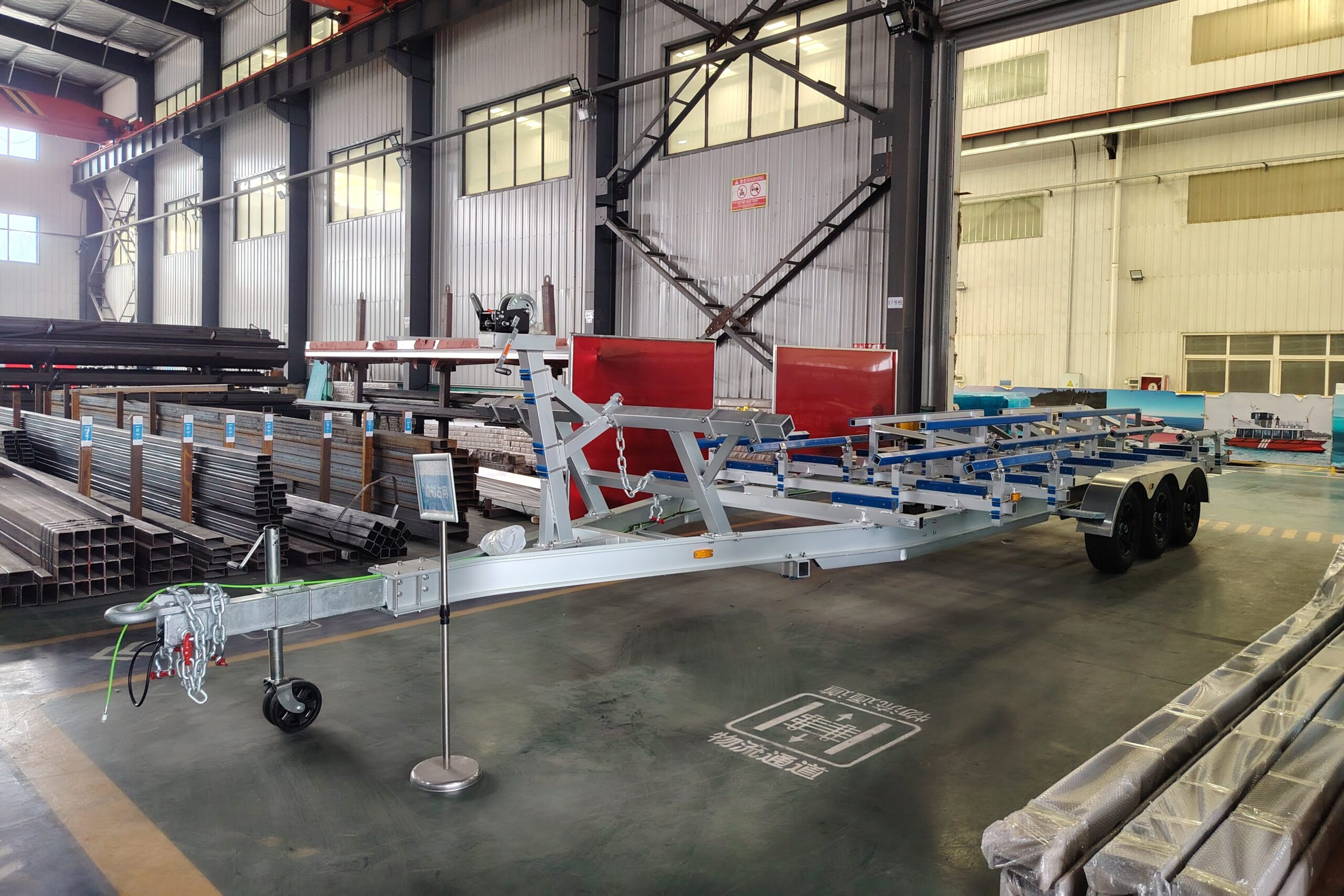
Why a V-Bunk Trailer Cannot Carry a Pontoon
The load path is fundamentally different, and that is the whole story of pontoon trailers. Everything else — bunk design, guide-ons, tie-down points, tongue weight — follows from it.
A V-hull is a wedge. Its weight lands on the keel line and on the two chines, and a bunk or roller set up for that shape touches the hull at a handful of deliberately placed points. The trailer’s job is to locate the hull precisely and hold it in the V, and because the hull is self-centering in that groove, it does not need to be supported along its whole length.
A pontoon has no keel and no deadrise. It is two or three cylinders, and a cylinder touches a flat surface along a single line. Set a pontoon down on V-bunks and the tubes contact the bunk edges, not the bunk faces. The load that should be spread across the tube’s lower surface concentrates into narrow bands, the tube deforms locally, and the deck and fencing above it are loaded in ways they were not designed for. That is the mechanism by which a pontoon boat gets damaged on a trailer that was never intended for it — not by the boat falling off, but by the hull being dented and stressed a little more on every trip.
| Aspect | V-hull on a V-bunk trailer | Pontoon on a V-bunk trailer |
|---|---|---|
| Where the weight sits | Concentrated along the keel line | Split across two or three parallel tubes |
| Contact geometry | Bunk faces match the deadrise angle | A cylinder touches a flat bunk along one line only |
| What the trailer must do | Locate the hull precisely and hold it in the V | Carry each tube along its length, without local point loads |
| Failure mode when mismatched | Hull rocks; no self-centering; the boat sits differently each launch | Tube deformation, fence and deck stress, repeated impact damage |
The correct arrangement is a bunk or pad that runs parallel to each tube and contacts it along a meaningful length, with the reaction perpendicular to the tube surface. Working out the right bunk length and spacing for a given tube diameter and boat mass is the part worth getting right before you buy — see choosing the right boat trailer support type for how the support types differ, and boat trailer sizes and weight capacity for matching capacity to a larger, lighter hull.
Twin-Tube vs Tritoon: The Center Tube Is Not Optional
A tritoon needs support under all three tubes, and leaving the center tube unsupported is the single most common mistake in pontoon trailering.
The center tube is part of the hull structure, not an accessory bolted underneath it. It carries a share of the boat’s weight and it stiffens the whole assembly. Support only the two outer tubes and you have done two things at once: you have reduced the number of load paths by a third, so each outer tube now carries more than it was proportioned for, and you have left the center tube spanning unsupported between whatever structure ties it to the outer tubes.
The consequences show up gradually rather than at once. The outer tubes take a set over time, the deck and fence develop stress cracks around attachment points, and the boat starts sitting differently on the trailer after each launch because the tubes are no longer straight. On a boat with a heavy four-stroke engine on the transom, the rear of the center tube is carrying the most concentrated load on the whole hull, and it is the part most often left dangling.
If you already own a two-bunk pontoon trailer and tow a tritoon, the honest answer is that it is the wrong trailer. Adding a center bunk is sometimes possible if the frame and crossmembers were designed to accept one; adding it to a frame that was not designed for it just moves the problem into the trailer’s structure. Ask the manufacturer before modifying.
Pontoon Trailer Width and Oversize Permits
Pontoon boats are the category most likely to push a trailer over the 8.5 ft (102 in) interstate width limit, because the hull is as wide as the deck.
That width limit is a federal interstate figure. A few states are stricter and use 8 ft as their own limit — New York, New Jersey and Hawaii among them — which means a rig that is legal on the interstate can be over-width on some of the roads you need to reach the ramp. Over-width also means an oversize permit, and permits commonly come with route restrictions and, in some jurisdictions, limits on when you may travel.
| Trailer / boat beam | Permit position | What it usually means |
|---|---|---|
| Up to 8 ft (96 in) | No permit anywhere | Legal in the stricter states as well as on the interstate |
| Over 8 ft (96 in) up to 8.5 ft (102 in) | No federal permit, but at or above the limit in stricter states | Route matters more than the trailer; check every state you cross |
| Over 8.5 ft (102 in) | Oversize permit required | Expect route restrictions and possible time-of-day limits |
Work out the number before you order. Measure the widest point of the boat, not the trailer frame, and add any wakeboard tower or railing overhang. Width rules, permit thresholds and escort requirements vary by state and are worth confirming with the relevant state DOT rather than assuming — this depends on your jurisdiction, and the rules on secondary roads are often not the same as the interstate rule.
Tie-Down Points on a Boat With This Much Windage
A pontoon cannot be secured by the bow winch strap alone, because the fence panels and deck give it a large sail area and the stern will walk sideways in a crosswind.
The bow eye and winch post hold the boat fore and aft. They do not restrain lateral movement, and on a flat-bottomed, high-sided boat, lateral movement is the real risk. What you want is four points of restraint that form a stable pattern:
| Position | What it controls | Notes |
|---|---|---|
| Bow eye to winch post | Fore-and-aft movement | Necessary, but not sufficient on its own |
| Two stern tie-downs, port and starboard, angled slightly outward and rearward | Lateral walk and rear lift — the main restraint | Anchor to the trailer frame, not to a bunk bracket |
| Aft cross-strap over the deck or tubes | Vertical lift and lateral movement in crosswinds | Keep clear of the engine and any fuel lines |
| Optional midship pair on very long hulls | Reduces lateral walk on the longest boats | Only at points rated for it on the hull |
Two errors are worth calling out. The first is tying down through the fence or railing. Those panels carry wind load when the boat is on the water, but they are not structural hard points for a 60 mph trailer load, and they will deform or tear. Anchor to the tubes or the deck structure. The second is relying on the winch strap plus a single stern strap and calling it secure. A pontoon that shifts laterally on a trailer loads the bunk mounts and the tubes, which is the same damage the wrong trailer causes through a different route.
Guide-Ons: What They Do and Where to Put Them
Guide-ons exist to align a pontoon at the ramp, and their job is to guide — not to carry the boat’s weight.
Pontoon boats are hard to load in a crosswind or a running current because the hull presents a large flat side to both. A pair of tall vertical guide posts set outside the two outer tubes at the rear acts as a funnel: the tubes enter between them and the boat self-centers as it comes forward onto the bunks. Long guide-on bunks that run parallel to the tubes and sit slightly above the main bunks do the same job more gently, and are a better choice where the ramp is steep or the boat is driven on under power.
Position matters more than style. Set the guides so they contact the tube below its widest point but above the bottom, so they can steer the tube without bearing the hull’s weight once the boat is fully on. If the guide posts are carrying load at rest, they are set too high or the main bunks are too low. A bow guide at the front is a useful addition on a boat with a lot of freeboard, because it stops the bow from drifting off-center while the stern is still swinging.
Tongue Weight on a Pontoon Trailer
Tongue weight is easier to get wrong on a pontoon than on almost any other boat, because the hull is large and light and the engine sits at the very back.
For a boat trailer, target 5–10% of gross trailer weight, with most manufacturers recommending 7–10%. Below 5% the trailer will sway at speed and can fishtail when you are overtaken or hit a crosswind — a real risk on a boat with this much sail area. Above roughly 10–12% you start overloading the tow vehicle’s rear axle, which unloads the front axle, lightens the steering and extends braking distance.
Pontoon hulls have most of their buoyancy and most of their structure at the ends, and the outboard or sterndrive puts a concentrated mass on the transom. That combination pushes the center of gravity further back than most owners estimate, so a pontoon that “looks balanced” on the trailer is often light on the tongue. The practical fixes are the same as for any trailer: move the boat forward on the bunks by adjusting the winch post and bow stop, or move the axle assembly — forward reduces tongue weight, rearward increases it, and most manufacturers cap a single move at 6 inches without written approval. Move the axle and you must confirm it is square to the direction of travel and retorque the fasteners. The boat trailer tongue weight guide covers the measurement methods, including the bathroom-scale lever method and the weighbridge difference method.
Two reminders that catch people out. Tongue weight counts against the tow vehicle’s payload, not its towing capacity, so it competes with passengers and luggage. And the trailer should sit level or slightly nose-down; towing nose-up makes sway worse, which is the last thing a high-windage pontoon needs.
Frequently Asked Questions
Can I put a pontoon boat on a regular boat trailer?
No, not safely. A V-bunk trailer contacts a cylindrical tube along a single line rather than across a bunk face, so the load concentrates into narrow bands and the tubes deform locally. The boat also has nothing to self-center against, so it sits differently after every launch. Pontoon trailers exist because the load path is different, not because the boats are wider.
Do tritoons need a third bunk?
Yes. The center tube is part of the hull structure and carries a share of the weight, so supporting only the outer two tubes loads them beyond what they were proportioned for and leaves the center tube spanning unsupported. Over time that shows up as tubes taking a set, stress cracks around deck and fence attachment points, and a boat that no longer sits straight.
Do I need a permit to tow a pontoon boat?
Only if the rig exceeds the width limit. The federal interstate limit is 8.5 ft (102 in), and a few states — New York, New Jersey and Hawaii among them — use 8 ft instead. Over 8.5 ft (102 in) you need an oversize permit and should expect route restrictions. Measure the widest point of the boat, including any tower or railing overhang, and confirm with the state DOT.
How much tongue weight should a pontoon trailer have?
Target 5–10% of gross trailer weight, with most manufacturers recommending 7–10% for boat trailers. Below 5% the trailer will sway; above about 10–12% you overload the tow vehicle’s rear axle. Pontoon hulls sit further back than owners expect because the engine is on the transom, so measure rather than estimate.
What are guide-ons for on a pontoon trailer?
They align the boat at the ramp when wind or current is pushing it sideways. Vertical posts set outside the outer tubes funnel the tubes into position; long guide-on bunks work the same way more gently. They are for guiding only — if the guides are carrying the boat’s weight once it is loaded, they are set too high.
How wide is a pontoon trailer?
Wide enough that it is the category most likely to cross the 8.5 ft (102 in) interstate limit, because the hull is as wide as the deck. That is why pontoon trailers are usually the widest trailers in a manufacturer’s range, and why the width question should be answered before you order rather than after the boat arrives.
Pontoon and tritoon trailers are a different build from a V-hull trailer, and the bunk layout has to be matched to your tube diameter, tube count and boat mass rather than picked from a size chart. Our hot-dip galvanized twin-axle marine trailer is built for saltwater launching, and we configure bunk and guide-on layouts to the boat. Send us your beam, tube count and ready-to-tow weight via the contact form and we will confirm what fits.
- Pontoon and Tritoon Trailers: Why Standard Bunks Don’t Work on Flat Hulls
- Hot-Dip Galvanizing for Boat Trailers: Coating Thickness, Lifespan and Limits
- Galvanic Corrosion on Boat Trailers: When Aluminum Meets Galvanized Steel
- Shipping Boat Trailers Overseas: Container Loading, SKD vs Fully Built, and Landed Cost
- Boat Trailer Cost: Aluminum vs Galvanized — A 10-Year Ownership Comparison