
Shipping a boat trailer overseas is a volume problem, not a weight problem. A 40HQ gives you about 76.4 m³ of space and roughly 26.5 t of payload, but trailers cube out long before they weigh out, so units per container is set by disassembly and nesting rather than tonnage. Unit logistics cost = total per-container charges ÷ units per container.
The Number That Decides the Deal Is Cost per Unit Landed
An importer’s real cost is the trailer price plus every charge incurred before the unit can be sold, divided by the number of units in the shipment. Two suppliers can quote the identical trailer at the identical FOB price and produce completely different outcomes, because most of the money in an ocean shipment is spent per container, not per trailer.
A manufacturer’s quotation tells you what leaves the factory, not what arrives on your yard. In between sit inland haulage, export documentation, ocean freight, insurance, terminal handling, customs clearance, drayage, duty, and the labor to turn packed units back into sellable trailers. Add assembly space and demurrage risk, and a shipment that looked 10% cheaper per unit can end up more expensive. Packing method determines how many units a container holds, and that figure divides almost every fixed charge in the shipment — so it has to be settled in the factory, not at the port.
Fully Built, SKD and CKD: What Each Format Actually Changes
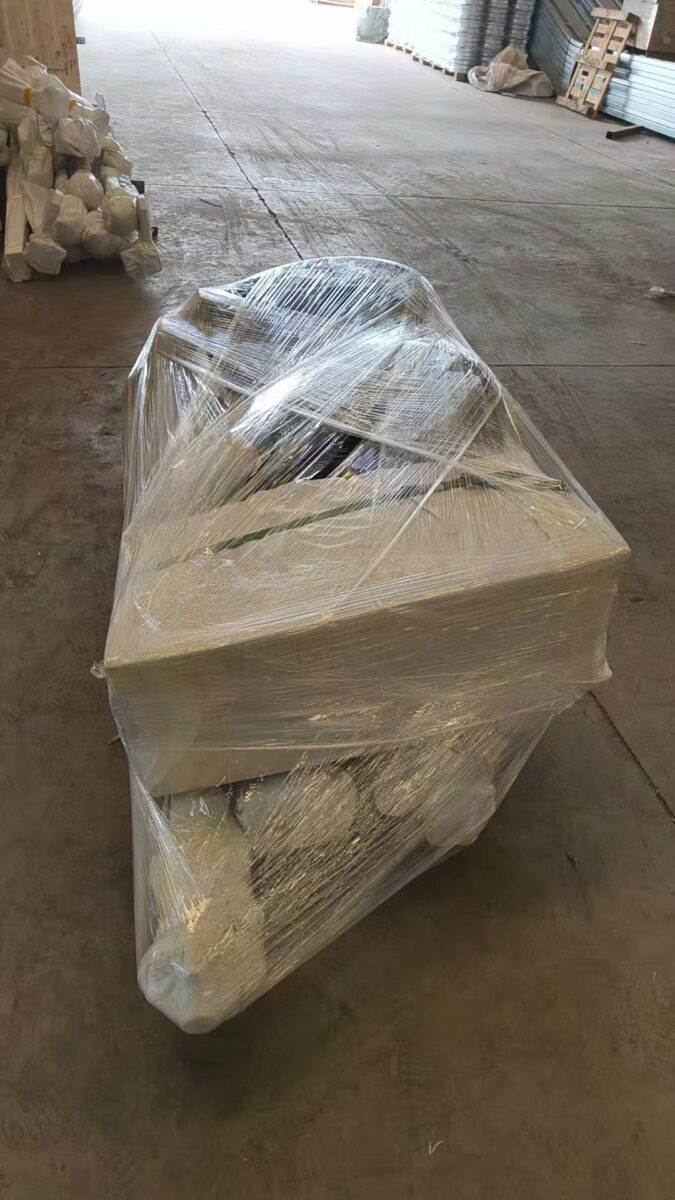
Fully built means the trailer ships ready to register. SKD (semi-knocked down) ships the frame with bolt-on assemblies boxed. CKD (completely knocked down) ships frame segments flat, everything else loose.
| Factor | Fully built | SKD | CKD |
|---|---|---|---|
| Units per 40HQ (relative) | Baseline — the lowest | Typically 2–4× fully built | Highest of the three |
| What comes off | Nothing | Wheels, fenders, tongue, lights, often axles | All of the above, plus joining hardware |
| Destination assembly labor | None | Low — bolt-on and torque | High — assembly, alignment, wiring |
| Local technical capability | None | Hand tools, torque wrench, basic electrical work | Workshop with frame alignment capability |
| Transit damage risk | Highest — lights and fenders exposed | Moderate — gear boxed, frame exposed | Lowest per part, but more parts to track |
| Duty and classification | Complete trailer | Usually complete trailer | Different tariff lines may apply |
| Time to sellable stock | Same day | Days | Days to weeks |
| Best fit for | First orders, low volume, no assembly capability | Steady volume with a small assembly bench | High-volume importers running assembly and QC |
Treat the classification row with caution rather than as a rule: tariff treatment of knocked-down versus assembled goods varies by jurisdiction and by how the goods are declared, so confirm it with your own customs broker.
What a 40HQ Container Actually Allows
A 40HQ is a fixed box, and the door opening rather than the internal volume is what most trailers have to pass through.
| Parameter | Value |
|---|---|
| Internal length | 12.032 m |
| Internal width | 2.352 m |
| Internal height | 2.698 m |
| Door opening width | 2.340 m |
| Door opening height | 2.585 m |
| Internal volume | approximately 76.4 m³ |
| Tare weight | approximately 3,900 kg |
| Maximum payload | usually around 26.5 t, varying by shipping line |
The door is 12 mm narrower and 113 mm lower than the box behind it, so any component wider than 2.340 m or taller than 2.585 m has to come off before loading, however much room exists further inside. Compare payload with volume and the shape of the problem appears: 26.5 t spread across 76.4 m³ requires cargo averaging about 347 kg per cubic meter for the container to weigh out.
Where Trailer Geometry Fights Container Geometry
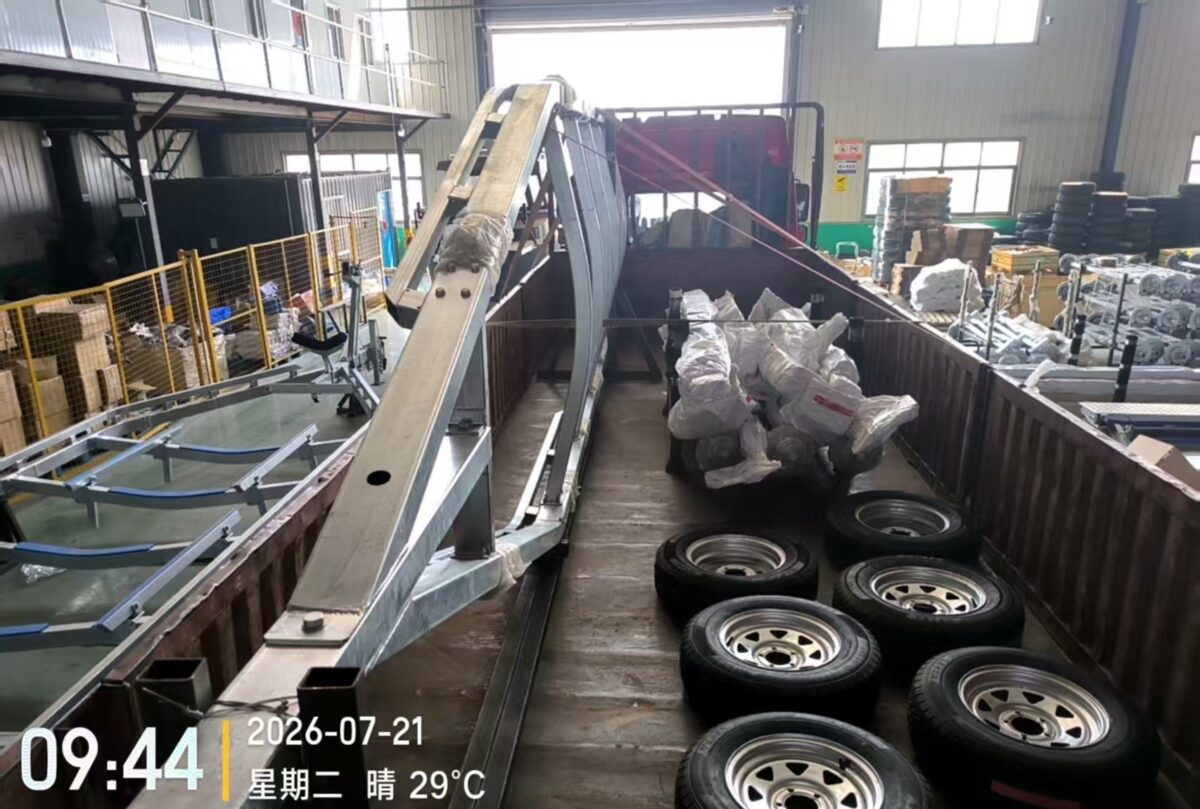
Almost every road-legal boat trailer is longer or wider than a 40HQ door once running gear and tongue are fitted, which is why loading plans are built around angles and disassembly rather than straight roll-in.
- Width. Beam at the axle line is usually the widest point of a road-legal trailer, and the door gives you 2.340 m. Wheels and fenders come off, or the unit is angled through.
- Height. Winch posts and guide-on uprights sit above the frame line, and the door height is 2.585 m. Tall fittings come off, or the unit loads on its side.
- Length. Frame length plus tongue and rear overhang against 12.032 m of internal length. The tongue usually adds more than a meter, forcing diagonal placement or one unit per row.
- Protrusions. Axle ends, hubs, couplers and mudguards occupy space that looks empty on a top-down drawing, and they are the most expensive items to repair if a load shifts.
Loading a trailer diagonally buys length but costs width, because a rotated rectangle needs a wider corridor than an aligned one. The same arithmetic governs a flatbed trailer shipment: measure the largest bounding rectangle at every stage of the load, not the nominal length.
Volume vs Weight: Trailers Are Cube-Limited, Not Weight-Limited
A container full of boat trailers almost always hits the volume ceiling while a large part of its payload goes unused, because a trailer is mostly air. Frames are lattices, and a stack of frames is a taller lattice. To weigh out at 26.5 t inside 76.4 m³, the cargo would need to average roughly 347 kg per cubic meter throughout the whole box — a figure that frames, fenders, axles and boxed wheels generally do not reach once packed for shipping.
The consequence is decisive for the entire cost model. If weight is not the binding constraint, nothing is gained by paying more for lighter material, and everything is gained by making each unit smaller in packed volume. Optimisation effort belongs in disassembly and nesting, not weight reduction.
How to Work Out Whether You Are Cube-Limited or Weight-Limited
Two divisions tell you which constraint governs your shipment, and the smaller result wins.
- Units by volume = usable internal volume ÷ packed volume of one unit, measuring the bounding box of the frame stack plus boxed gear.
- Units by weight = maximum payload ÷ packed weight of one unit, including all boxed parts and packaging.
- The lower figure is your realistic container yield. If the volume result is lower, you are cube-limited.
Consider a hypothetical example. Take a 4.8 m trailer with a 2.0 m beam, stripped to SKD with axles, wheels, tongue and fenders boxed separately. The stripped frame laid flat occupies about 4.9 m × 2.1 m, and the container floor is 12.032 m × 2.352 m, or 28.3 m², so two frames fit per layer. At roughly 0.35 m of stack height and a practical three-layer stack, that is six frames plus loose parts in the remaining floor area.
Now the weight check. If each packed unit weighs around 500 kg, the 26.5 t payload would allow roughly 53 units. Volume allows six — weight is nowhere near binding. Run the same two divisions with your own footprint and mass and you will find the same shape of answer, which is why the loading plan rather than the steel grade is the lever.
Loading Rate Optimisation: What Actually Moves the Number
Gains come from a short list of decisions, each with a benefit and a cost.
- Choose the disassembly level per order. Base it on what your destination operation can genuinely reassemble, not on the freight quote. A saving that creates warranty claims is not a saving.
- Remove the tongue and coupler. Usually the largest length gain. Cost: a bolted joint that must be re-torqued and a coupler to protect.
- Pull the wheels and fenders. The largest width gain, and usually what solves the door-opening problem. Cost: lug torque and seal integrity must be verified after reassembly.
- Decide whether axles travel fitted or boxed. Fitted keeps reassembly simple but consumes height and width at the widest point; boxed frees the door envelope at the cost of a brake and alignment check.
- Nest rather than stack blindly. Wheels and axle assemblies belong inside frame voids, not on top of them. Vertical space above a low frame stack is free floor area.
- Block and brace to a written loading plan. Transit damage is the most common source of claims on trailer exports and is almost always a bracing failure.
- Protect every contact point. Straps tightened onto bare metal edges cut through coatings and start the corrosion that appears six months after delivery.
- Package for humidity and salt, not just handling. Containers swing through large temperature and humidity changes, so bearings, connectors and brake parts need voyage protection.
Material choice connects directly to that last point. A hot-dip galvanized twin-axle marine trailer is built for this environment, and under ISO 1461 the coating is a metallurgical bond rather than a paint film, with zinc continuing to protect the steel as a sacrificial anode where the coating is damaged. Under ISO 9223, a zinc coating typically loses 0.5–4 µm per year depending on how corrosive the environment is, while unprotected iron corrodes roughly 200 times faster. For the voyage itself, use vapor-phase protection on machined surfaces, sealed bags for bearings and hardware, and a desiccant load matched to container volume and voyage length.
Unit Logistics Cost: The Formula, and the Variable That Matters Most
Unit logistics cost per trailer is the shipment’s total charges divided by the units in it:
(Ocean freight + inland transport to port + export customs and documentation + marine insurance + destination terminal handling + customs clearance and brokerage + drayage to your yard + duty and taxes + destination assembly labor) ÷ units per container
Watch what the denominator does. Ocean freight, terminal handling, clearance, brokerage and drayage are quoted per container or per shipment, so they are broadly fixed once booked, and doubling units halves them per unit. Assembly labor and duty scale differently — assembly is per unit, duty may be per unit or ad valorem — which is why the format decision has to be modelled. Units per container is the highest-leverage variable and the hardest to change after the fact.
Landed Cost: The Full Stack You Have to Model
Landed cost is every charge between the factory gate and a unit being sellable on your yard, expressed per unit.
| Cost line | Charged per | Commonly overlooked |
|---|---|---|
| Product cost at agreed trade term | Unit | Whether packing, blocking timber and SKD fasteners are included |
| Inland transport to load port | Container | Repeat pickups if production is staged over months |
| Export documentation and customs | Shipment | Certificates of origin and legalisation fees |
| Ocean freight | Container | Rate movement between quotation and booking |
| Marine insurance | Value | Whether corrosion and handling damage are covered, not only total loss |
| Destination terminal handling | Container | Port charges move independently of freight rates |
| Clearance and brokerage | Shipment | Local inspection and quarantine fees |
| Duty and import taxes | Unit or value | Classification of knocked-down versus assembled goods |
| Drayage to your yard | Container | Whether your site accepts a 40 ft container without a crane |
| Assembly, re-torque, space and tooling | Unit and fixed | Labor, torque wrench, hardware, quality records, assembly area |
| Compliance and registration | Model or unit | Type approval sits with the model, so small volumes carry it harder — see boat trailer regulations by country |
| Demurrage and detention risk | Container per day | Free time is set by the shipping line and terminal, not the seller. Confirm the free days before the container sails. |
Two lines are easy to underestimate. Compliance is a fixed cost charged per model, so it punishes small batches, and assembly cost includes the space, tooling and quality checks that stop a reassembled trailer becoming a warranty claim. The same discipline applies to material choice: the purchase price is only one line, as our 10-year cost comparison of aluminum versus galvanized trailers sets out.
Frequently Asked Questions
How many boat trailers fit in a 40ft container?
There is no single answer, because it depends on trailer length, beam and how far the unit is disassembled. Divide the usable internal volume by the packed volume of one unit, then divide the maximum payload by the packed weight of one unit, and take the lower result. For almost all boat trailers the volume calculation binds first.
Is it cheaper to ship a boat trailer fully assembled or in parts?
Per container, shipping in parts is almost always cheaper, because you fit more units into the same box and most of the freight bill is charged per container rather than per trailer. Whether it is cheaper in total depends on destination assembly labor and local technical capability.
What do SKD and CKD mean for trailer exports?
SKD means semi-knocked down: the frame ships largely complete, with wheels, fenders, tongue, lights and often axles removed and boxed for reassembly at destination. CKD means completely knocked down: frame sections and every other component ship as loose parts. SKD suits importers with a small assembly bench; CKD suits importers who already run assembly and quality control.
Why is the container weight limit not the problem when shipping trailers?
Because a trailer is mostly air. A 40HQ offers about 76.4 m³ and roughly 26.5 t of payload, so the cargo would have to average about 347 kg per cubic meter to weigh out. Loose frames, fenders, axles and boxed wheels sit below that density, so the container cubes out with much of its payload unused.
What is the landed cost of a boat trailer?
Product price plus inland transport, export documentation, ocean freight, insurance, destination terminal handling, clearance, drayage, duty and taxes, assembly labor, compliance costs and any demurrage. Divide the total by units per container for a per-unit figure you can compare against your selling price. The per-container lines improve fastest when you raise units per container.
Do I need to assemble trailers at the destination port?
Only if you choose a knocked-down format. Fully built units need no assembly. SKD units need bolt-on work and correct torque on wheel nuts, couplers and suspension fasteners. CKD units need a workshop, frame alignment capability, electrical checks and a documented re-torque step.
Packing format, loading plan and landed cost interlock, so a useful quotation starts from three facts: your trailer model and its dimensions, your destination port, and your expected annual volume. Send those to our export team and we will work through the volume and weight arithmetic with you. Qingdao Hyroad Trailer Co., Ltd. manufactures and exports marine, horse, flatbed and box trailers from Qingdao, China, and holds ISO, WMI, CE, US DOT, EU WVTA and Australian VTA certifications.