Here’s the uncomfortable truth most trailer listings won’t tell you: a wheel coming off at 70 mph is how a great launch day ends. Not “someday maybe” — it’s the single most common trailer failure in salt-water boating, and it almost always traces back to one boring cause. The owner never took the trailer seriously, because it looked fine.
A trailer is not a boat accessory. It’s the part of your rig that spends 100% of its life unseen — until it isn’t. This guide walks through the decisions that actually keep you on the road: water type, frame material, capacity, axle count, brakes, and the paperwork importers get burned by. No glossy adjectives. Just the stuff that fails, and the numbers that stop it.
Start with water, not with price
Saltwater is a silent thief. If your boat lives in or near salt, your material decision is already made for you — you’re just arguing about how fast corrosion wins. Freshwater owners have far more slack.
- Saltwater / brackish: You need a marine-grade frame. Painted steel is out. Hot-dip galvanized or aluminum, full stop.
- Freshwater only: Galvanized still wins on value; aluminum is a nice-to-have, not a must.
- Mixed / seasonal / anywhere it snows: Road salt is the same chemical problem as ocean salt. Treat winter launching like saltwater.
If a seller talks “great price” before they ask where you launch, that’s your first red flag.
Frame material: aluminum vs. hot-dip galvanized vs. painted steel
This is the decision that decides your trailer’s 10-year cost, not its sticker price.
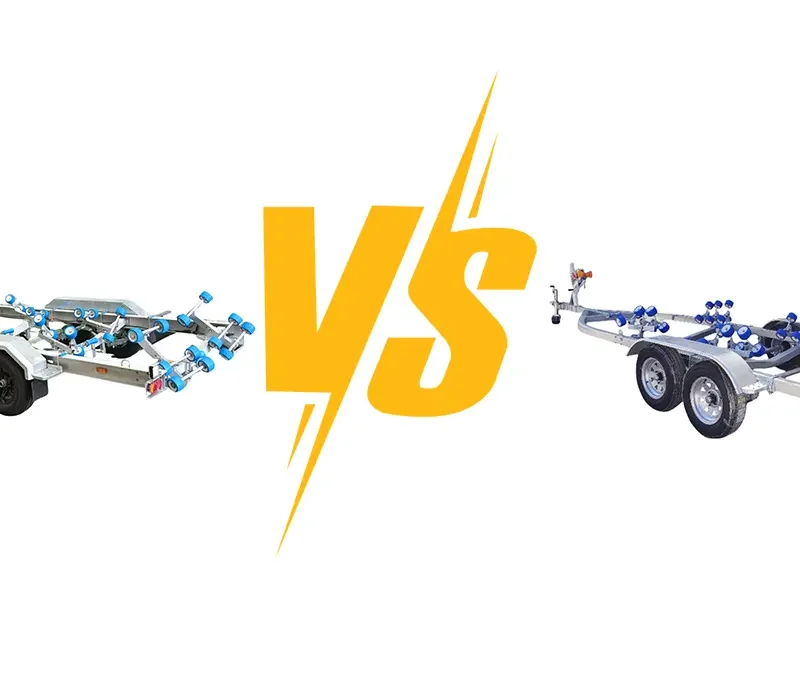
Hot-dip galvanized steel — the workhorse. The whole frame is dipped, so cut edges and welds are still protected. It shrugs off salt for years and costs less per pound than aluminum. The trade-off: it’s heavy. On a 7–9 m boat that extra 150–250 kg of tare weight eats into your tow vehicle’s payload and your fuel.
Aluminum alloy — the lightweight play. Roughly 40–50% lighter than a comparable steel frame. Easier on the tow vehicle, better launching on soft ramps, no rust ever. The trade-off: higher upfront cost, and it demands correct galvanic isolation (stainless or insulated hardware) or it eats itself at the bunks. Done wrong, aluminum corrodes faster than steel.
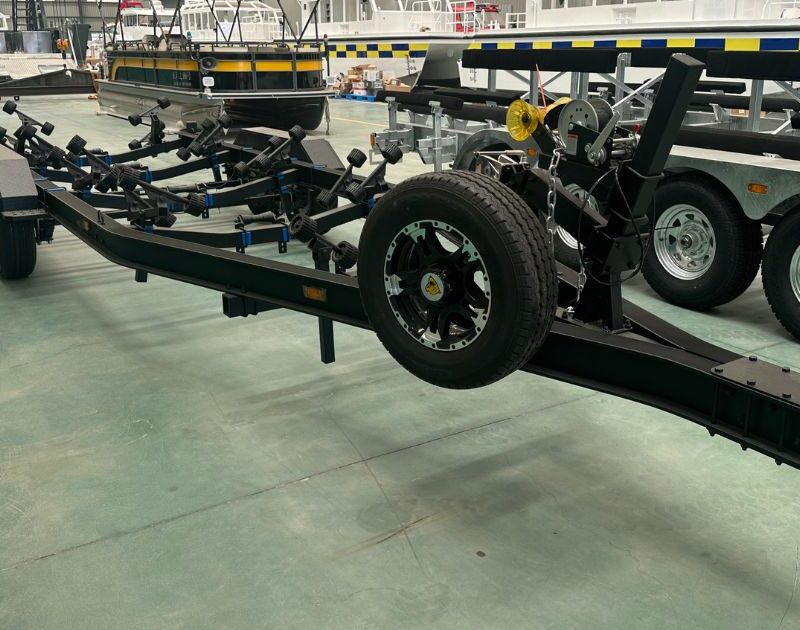
Painted / powder-coated steel — avoid for marine use. The paint is a band-aid. One ramp scrape and the bare steel underneath starts rusting from inside out. Fine for a freshwater farm trailer. Never for a boat.
Size it by GVWR, then check tongue weight
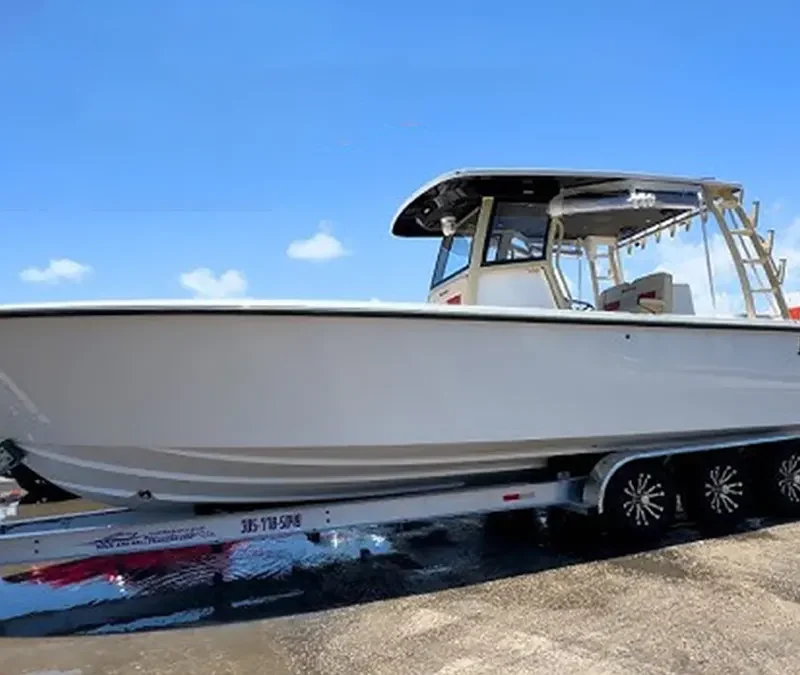
GVWR (Gross Vehicle Weight Rating) is the only capacity number that matters. Your trailer must be rated above boat + motor + fuel + gear + trailer tare. A 1,800 kg boat on a “2,000 kg” trailer is a lie if the trailer itself weighs 400 kg — you’re already at 2,200 kg.
Tongue weight should sit at 10–15% of total loaded weight. Too low (under 10%) and the rig sways; too high (over 15%) and your rear axle squats and the front lifts. Both are how trailers end up in ditches. Weigh it, don’t guess it.
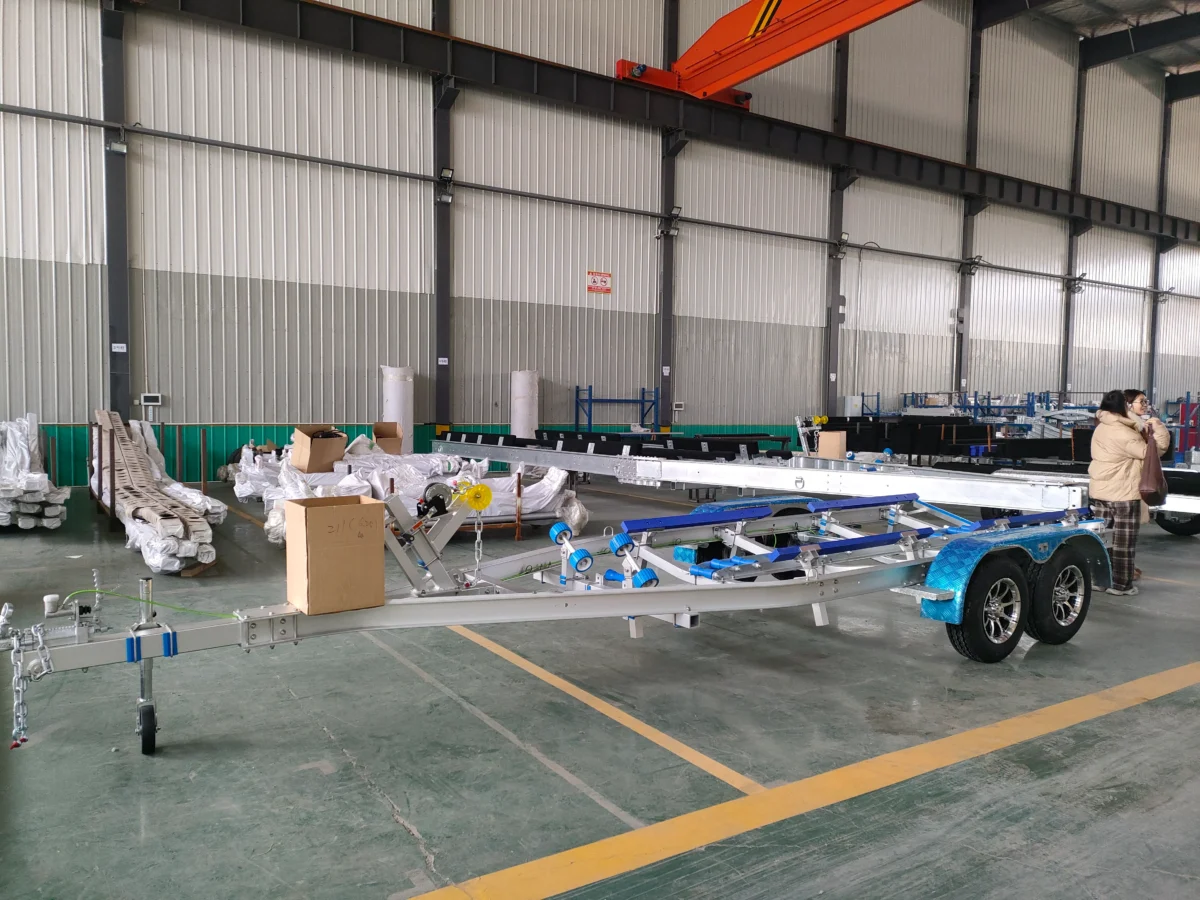
Hyroad builds boat trailers from 4 m to 13 m, single-axle up to five-axle, so the frame can be matched to the actual boat rather than “close enough.” Matching matters more than the brochure photo.
Axle count: more than a load number
Single axle — light boats under ~1,500 kg loaded. Cheap, simple, one less bearing set to maintain. But one tire failure = you’re stopped. No redundancy.
Tandem (2 axle) — the sweet spot for most 5–8 m boats. A blown tire still lets you limp to a safe spot. Better braking, better stability.
Triple and up — sailboats, big center consoles, 10 m+. Hyroad’s larger custom frames run triple and five-axle for sailboats with deep keels and off-center balance points. More axles = more bearings to service, not free reliability.
Owner reports on The Hull Truth and r/boating are near-unanimous: buy one axle size up from the minimum rating. The “just enough” trailer is the one that fails first.
Brakes: surge vs. electric-over-hydraulic
Salt kills electric brakes. If you launch in saltwater, electric-over-hydraulic actuators that sit low on the tongue drown and corrode. Surge (hydraulic, activated by momentum) is the saltwater-standard for a reason — fewer electrical parts in the splash zone.
- Surge hydraulic: reliable in salt, simpler, no breakaway wiring complexity. Slower to engage than electric.
- Electric-over-hydraulic (EOH): gives you in-cab brake control and integrates with a brake controller; needs the actuator kept dry and flushed after salt.
- Breakaway cable + battery: non-negotiable. If the trailer separates, the brakes must lock. No cable, no sale.
The certifications importers get burned by
If you’re a dealer, distributor, or fleet buyer, the trailer is worthless without the paper that lets it roll legally in your market.
- CE / WVTA — European road approval.
- DOT — North American compliance.
- Australian VTA — required for the Australian market.
- ISO / WMI — manufacturing and VIN-system credibility.
Hyroad holds ISO, WMI, CE, DOT, WVTA, and Australian VTA across its range — the kind of compliance checklist that separates a factory you can actually import from vs. one that looks cheap until customs says no. Ask for the certs before you quote freight, not after.
The maintenance rhythm that keeps you off the shoulder
None of the above matters if you skip this. The failure curve is brutal and predictable.
- Bearings: repack every 12–24 months, or every 3,000–5,000 km in saltwater use. This is the #1 cause of roadside fires. Grease is cheaper than a wheel.
- Rinse after every saltwater dip. Freshwater flush of the frame, lights, and brakes within the same day. “I’ll do it this weekend” is how hubs rust solid.
- LED lighting: sealed units outlast bulb fixtures in spray. Specify sealed LED, not “LED-compatible.”
- Spare tire + lug wrench on the trailer. Not in the garage. On the trailer.
- Safety chains crossed under the tongue. So if the coupler fails, the tongue drops onto the chains instead of the asphalt.
Where Hyroad fits (honestly)
We’re a manufacturer, not a magician — so here’s the straight version. Hyroad builds both hot-dip galvanized and aluminum boat trailers, 4–13 m, single to five-axle, with CE / DOT / WVTA / Australian VTA certification and one-stop axles, brakes, jacks, and winches. That range means we can spec the frame to your boat and your water, not push one “best” model.
Good for: importers and dealers who need certified, customizable trailers matched to local road and marine standards; owners who want aluminum lightness or galvanized value without compromise on corrosion protection.
Not for: buyers chasing the absolute lowest price who’ll skip maintenance anyway — a cheap trailer unmaintained is still a roadside fire. The frame material doesn’t cancel the bearing schedule.
Your pre-buy checklist
- Know your water: salt, fresh, or road salt?
- Pick frame material by water, not by looks.
- GVWR > boat + motor + fuel + gear + tare.
- Tongue weight 10–15% of loaded weight (weigh it).
- One axle size above minimum rated load.
- Surge brakes for salt; EOH only if you flush.
- Breakaway cable + battery present.
- Certs match your market (CE / DOT / WVTA / VTA).
- Sealed LED, spare tire on the trailer, crossed safety chains.
Tell us your boat length, weight, keel type, and where you launch — we’ll spec the frame, material, axle count, and brake system to match, and send the certs your market requires. Get a free quote at hyroadtrailer.com or email admin@hyroadtrailer.com.
A trailer is a multiplier on what your boat can do — but only if you take it seriously. The 20 minutes you spend on this checklist beats the 4 hours you’ll spend on the shoulder.