
An I-beam main member resists vertical bending better than channel and is common on heavier boat trailers; channel is lighter but traps water when its open side faces up. Steel frames are cheaper and weld easier, while aluminum resists corrosion and weighs less. Galvanizing or painting protects either against saltwater.
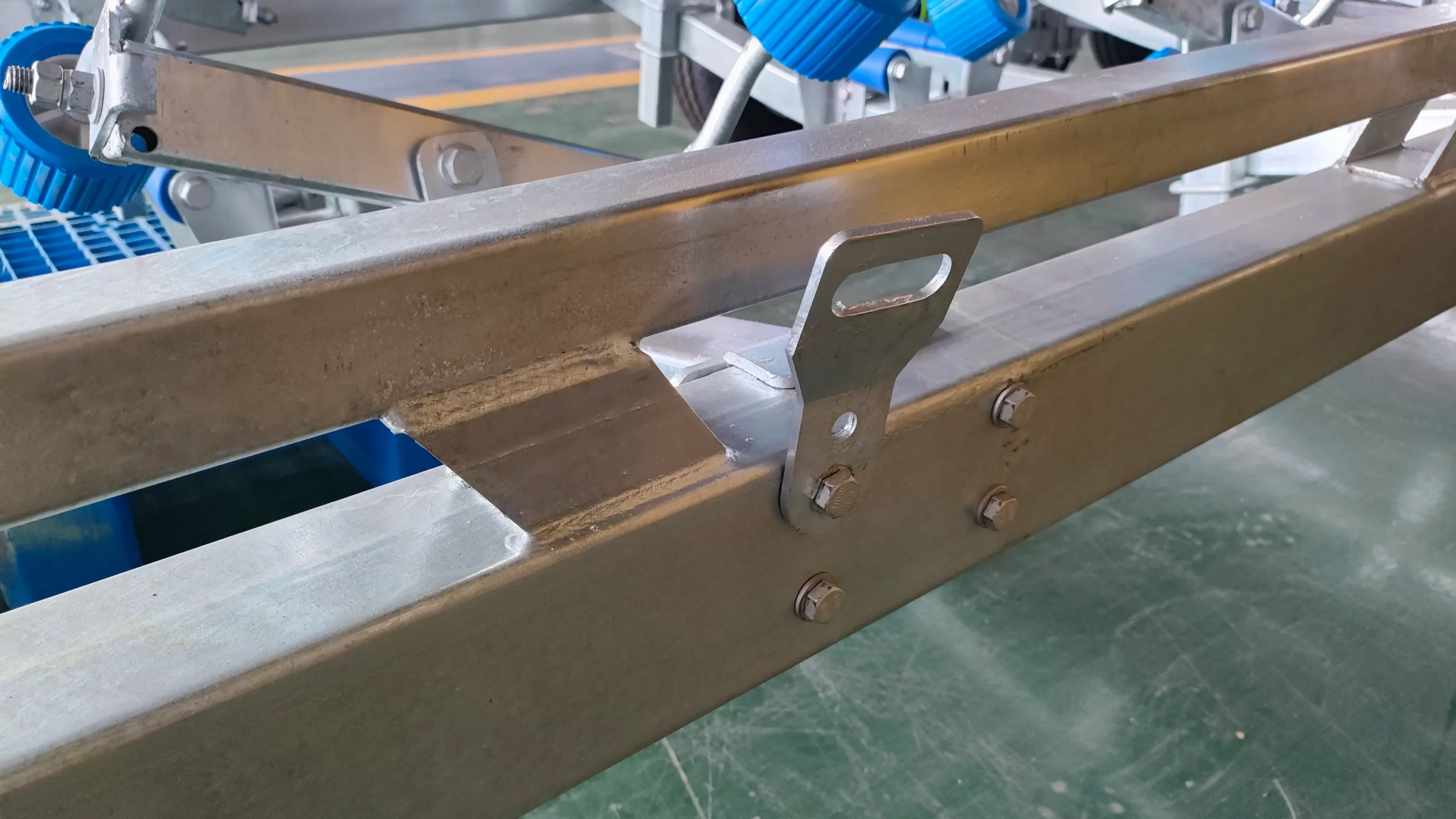
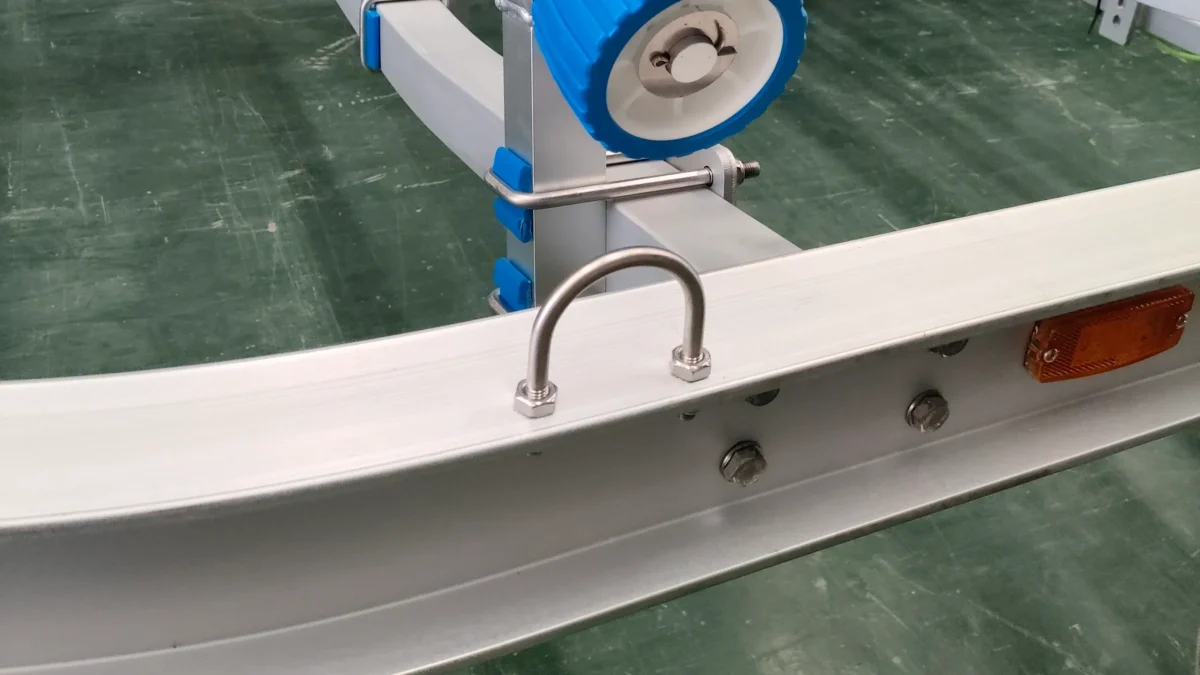
A boat trailer frame is the structure every other part bolts to, so the choice of beam shape and material sets the limit on how much boat it can carry, how long it survives in salt water and how heavy it is to tow. This guide compares the two main beam shapes and the two main frame materials, and explains how frame design feeds into tongue weight and tracking. Use it alongside the suspension choice, because the frame and axle have to be specified as one package.
What the frame does
The frame carries the boat’s weight and resists vertical bending and torsional twist while the trailer is moving and loading. Under braking, cornering and on a tilted ramp, the main beams see bending forces from the hull pressing down and dynamic forces from the road, while the whole chassis twists as one wheel drops into a pothole. A frame that is too flexible lets the bunks shift relative to each other, which can stress the hull; a frame that is too heavy simply costs more to tow.
For this reason the frame is specified by load capacity first, then by the beam shape and material that deliver that capacity with the right margin. Crossmembers, the tongue and the coupler all hang off the main beams, so their strength is only as good as the rails they attach to. A well-built frame spreads the load evenly and keeps the boat level behind the tow vehicle.
I-beam vs channel main beam
An I-beam main member resists vertical bending better than channel and is common on heavier boat trailers, while channel is lighter but traps water when its open side faces up. The I shape puts material at the top and bottom flanges where bending stress is highest, so for a given weight an I-beam is stiffer against the boat pressing down on the rail. That is why I-beam rails are the usual choice once a trailer moves past light duty.
A channel, or C-section, has one open side. If the open side faces upward, as it commonly does on a trailer built from channel, water and road grit collect in the trough and sit against the steel, so the rail can rot from the inside where you cannot see it. Building the channel open-side-down avoids the pooling but loses some mounting convenience. Channel is cheaper and easier to source, and for light, short trailers it is a reasonable choice provided drainage and coating are right. The table below contrasts the two beam shapes directly.
| Attribute | I-beam | Channel |
|---|---|---|
| Vertical bending strength | Higher for same weight | Lower for same weight |
| Typical use | Heavier, tandem trailers | Lighter, shorter trailers |
| Water trapping | Enclosed; less internal rot | Traps water if open side up |
| Cost and availability | Higher | Lower, easy to source |
| Mounting convenience | Flanges easy to bolt to | Open side handy but risky |
Steel vs aluminum frames
Steel frames are cheaper and weld more easily, while aluminum frames resist corrosion and weigh less, which is the central trade-off in frame material. Mild steel is inexpensive, widely available and straightforward to cut and weld with common equipment, so a steel trailer is usually the lower-cost build and the easier one to repair at a local fabricator. The cost is weight and corrosion: steel is dense and will rust without protection.
Aluminum is lighter, which frees up payload on the tow vehicle and makes the trailer easier to move by hand, and it forms its own protective oxide layer so it does not rust the way steel does. The downsides are higher material cost, harder welding that needs the right process and filler, and softness that can dent. For saltwater service the corrosion advantage is significant, which is why aluminum is common on marine trailers; the aluminum vs galvanized boat trailer comparison covers the two corrosion strategies in more detail. The table below sets the materials side by side.
| Attribute | Steel frame | Aluminum frame |
|---|---|---|
| Cost | Lower | Higher |
| Weight | Heavier | Lighter |
| Corrosion behaviour | Rusts; needs coating | Oxidises; no rust |
| Welding and repair | Easy, common process | Specialist process needed |
| Best for | Budget, inland use | Saltwater, weight saving |
Crossmembers and gussets
Crossmembers and gussets give the frame its lateral rigidity so the two main rails cannot rack sideways under load. Crossmembers are the shorter beams that bridge between the left and right rails; they carry the bunk brackets and axle mounts and stop the chassis from parallelograms when one wheel drops. Gussets are the triangular plates welded at joints such as where the tongue meets the rails or where a crossmember meets a rail.
A frame with too few crossmembers will flex torsionally even if the main beams are strong, which lets the hull twist on the bunks. Fabricators add gussets at high-stress corners precisely because that is where a flat weld alone would crack first. When you compare two trailers of similar rated capacity, look at the spacing and size of the crossmembers and at whether the main joints are gusseted, because those details matter as much as the beam shape for real-world stiffness.
How frame design affects tongue weight and tracking
Frame layout sets where the boat sits and therefore the tongue weight, which should fall in the 5–10% of gross trailer weight (GTW) range that most manufacturers recommend for a boat trailer. A frame that places the axle too far forward pushes too much load onto the coupler; too far back and the trailer becomes tail-heavy and difficult to control. The 5–10% figure is the marine norm, distinct from the 10–15% common on general cargo and RV trailers, so it is worth reading our dedicated boat trailer tongue weight guide when you set axle position.
Tracking, or how straight the trailer follows the tow vehicle, depends on the same geometry plus frame stiffness. A rigid, well-braced frame keeps the axles square to the tongue, so the trailer pulls true; a flexible frame lets the back end wander, especially at speed or in crosswinds. Tongue weight, axle position and frame rigidity work together, so none should be set in isolation. Check the legal and safe limits with your local authority, because towing rules differ by region.
Corrosion protection of the frame
Galvanizing or painting protects a frame against saltwater, and the right choice depends on the base material. For steel, hot-dip galvanizing to ISO 1461 is the common marine standard; the molten-zinc coating bonds metallurgically to the steel and sacrifices itself to protect scratches, which is why a hot-dip galvanized twin-axle marine trailer is a frequent choice for corrosive service. Liquid paint and powder coat are cheaper but rely on staying unbroken, and any chip exposes bare steel.
Aluminum does not need galvanizing because it forms its own oxide layer, but it introduces a different risk: where aluminum meets steel fittings in the presence of salt water, galvanic corrosion can attack the less noble metal. That is managed with insulated washers, compatible hardware and correct bonding rather than with a coating. A simple routine keeps either material going:
- Rinse the frame and fittings with fresh water after every saltwater launch.
- Inspect the coating or galvanized surface once a year for chips and white corrosion.
- Check that aluminum-to-steel joints stay insulated and the hardware stays tight.
- Confirm the maintenance interval with a local marine specialist, because water and climate vary.
Whatever the material, rinse the frame after saltwater use and inspect coatings annually; the exact maintenance interval depends on your local water and climate, so confirm a schedule that suits your conditions.
I-Beam vs Channel, Steel vs Aluminum: Which Frame to Build
The short answer is that heavier saltwater trailers tend toward I-beam aluminum or galvanized I-beam steel, while lighter inland builds can use channel or painted steel to save cost. Use the two tables above together with your boat weight, launch frequency and tow vehicle limit to settle the spec. The suspension you fit also plays in: torsion axles pair naturally with a low, light aluminum frame, and our boat trailer suspension guide explains that side of the package.
Frequently Asked Questions
Is I-beam or channel better for a boat trailer frame?
I-beam is stronger against vertical bending for the same weight and is the usual choice for heavier trailers. Channel is lighter and cheaper but, if its open side faces up, it traps water and can rot from the inside. For light, short trailers channel is acceptable; for anything heavy or saltwater-used, I-beam is the safer structure.
Should I buy a steel or aluminum boat trailer frame?
Steel is cheaper and easier to weld or repair locally, which suits budget and inland use. Aluminum is lighter and resists corrosion without rusting, which suits saltwater and weight-limited towing, at a higher material and fabrication cost. The right material depends on where you launch and how much you value low weight versus low price.
Does an aluminum boat trailer frame rust?
No, aluminum does not rust the way steel does because it forms a protective oxide layer instead of iron oxide. It can, however, suffer galvanic corrosion where it contacts steel in salt water, so fittings should be isolated and the right hardware used. Apart from that, an aluminum frame is largely immune to the rust that limits steel trailer life.
What tongue weight should a boat trailer have?
Most manufacturers recommend 5–10% of gross trailer weight (GTW) for a boat trailer, which is lower than the 10–15% typical of cargo and RV trailers. Too little tongue weight can make the rig unstable, and too much overloads the tow vehicle’s rear axle. Axle position on the frame is the main control you have over tongue weight.
Why does channel rust from the inside on a boat trailer?
Channel is a C-section with one open side. When that open side faces upward, rain and launch water collect in the trough and sit against the steel, while road grit holds moisture there too. The inside surface stays wet and out of sight, so it rusts long before the outside shows damage. Building the channel open-side-down avoids the pooling.
How is a boat trailer frame protected from corrosion?
Steel frames are commonly hot-dip galvanized to ISO 1461 or painted, with galvanizing preferred for saltwater because it protects scratches. Aluminum frames rely on their oxide layer and on preventing galvanic corrosion at steel contact points through insulation and correct hardware. Rinsing after saltwater use and inspecting coatings yearly extends the life of either material.
Need a frame specified for your boat, your water and your tow vehicle? Our engineers build I-beam and channel frames in galvanized steel and aluminum to marine standards and can match the beam and material to your launch routine. Contact us for a quote with your boat’s length and weight.
- Boat Trailer Frame: I-Beam vs Channel, Steel vs Aluminum
- Boat Trailer Suspension: Leaf Spring vs Torsion Axle
- Pontoon and Tritoon Trailers: Why Standard Bunks Don’t Work on Flat Hulls
- Hot-Dip Galvanizing for Boat Trailers: Coating Thickness, Lifespan and Limits
- Galvanic Corrosion on Boat Trailers: When Aluminum Meets Galvanized Steel
Leave a Reply