
A hot-dip galvanized boat trailer usually costs 25–50% less than the same specification in aluminum, but aluminum often wins on ten-year total cost of ownership in saltwater, because maintenance and resale value outweigh the fuel saving, which is small. In freshwater with light use and short ownership, galvanized stays the cheaper option overall.
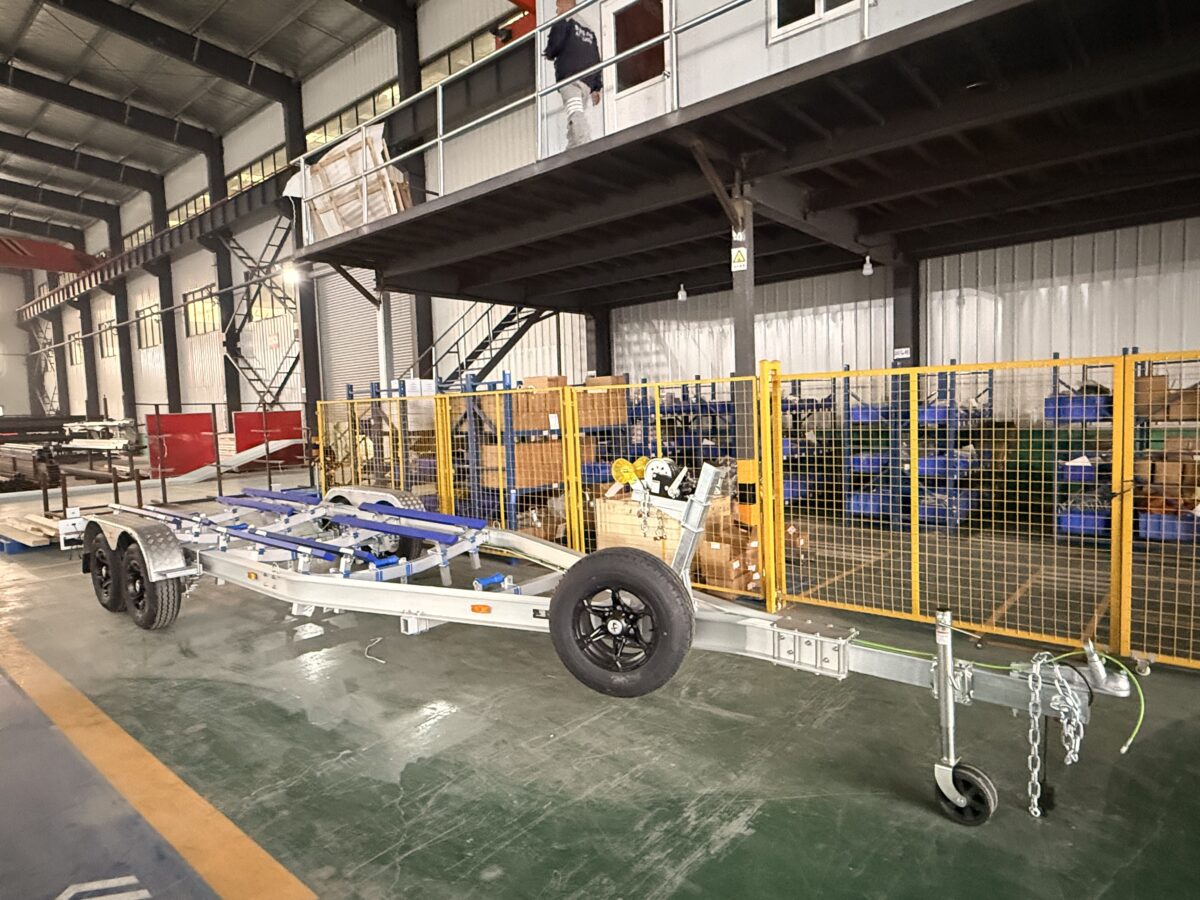
Total Cost of Ownership Has Four Lines, Not One
The cost of a boat trailer is four things added together: the purchase price, the maintenance you pay over the years you own it, the fuel it adds to towing, and what it is worth when you sell it. Most buyers compare only the first line, which is also the one that matters least in saltwater.
The two materials fail differently. Steel is protected by a zinc coating that is consumed over time, so maintenance is a running cost that grows with salt exposure. Aluminum does not produce red rust, so its costs are front-loaded into the purchase price and its value holds better at resale. Adding the four lines over a holding period turns a price argument into an ownership argument.
What Boat Trailers Cost: Broad Market Ranges
Purchase prices vary widely by material, size and market, and these are broad ranges rather than quotations.
| Material | Size class | Typical market range (USD) |
|---|---|---|
| Hot-dip galvanized | Single axle, light duty | US$1,500–3,500 |
| Hot-dip galvanized | Tandem axle, mid size | US$2,500–5,000 |
| Hot-dip galvanized | Large, tri-axle or pontoon | US$4,500–9,000 |
| Aluminum | Single axle, light duty | US$2,500–5,500 |
| Aluminum | Tandem axle, mid size | US$4,500–9,000 |
| Aluminum | Large or pontoon | US$8,000–16,000 |
These are market-typical ranges for general guidance, not quotations from any manufacturer. Actual prices depend on specification, region, exchange rates and freight, so ask the manufacturer for a quote.
Purchase Price: Why Aluminum Costs 25–50% More
Aluminum costs 25–50% more than hot-dip galvanized for the same trailer specification, and the premium comes from the material and the process rather than from branding. Aluminum extrusion costs more per kilogram than steel section, and aluminum welding needs a different process and more skill to avoid weakening the heat-affected zone. There is no galvanizing step, but there is surface treatment work instead, because aluminum needs its oxide layer managed and must be isolated wherever it touches steel. Fasteners and connection details are usually stainless, which adds cost again.
Galvanizing is priced largely by the weight of steel processed and by the coating thickness the standard requires, which is one reason a heavier frame is not automatically a cheaper frame. The hot-dip galvanized boat trailer route is a well-established process at volume, which is why the price gap exists at all.
Maintenance: The First Line Where the Gap Opens
Maintenance is where the two materials separate first, because a galvanized trailer in saltwater consumes its coating and needs repair, while an aluminum trailer does not rust but needs protection against a different mechanism.
Under ISO 1461 the zinc coating is a metallurgical bond rather than a paint film, and it protects steel sacrificially — but the coating is finite. Zinc corrodes at roughly 0.5–4 µm per year depending on how aggressive the environment is under ISO 9223, while iron corrodes about 200 times faster. In saltwater, expect to touch up scratches and cut edges with a zinc-rich primer and to replace brake and suspension parts once their coating has gone. ISO 1461 requires re-galvanizing once the uncoated area exceeds 0.5% of total surface area or 10 cm², which tells you when a patch job is no longer enough.
Aluminum behaves differently rather than better. It does not produce red rust, but it corrodes by pitting and in crevices, and it is anodic to steel in seawater. Where aluminum meets steel in an electrolyte, the aluminum is the part that corrodes — a real risk on an aluminum alloy twin-axle boat trailer fitted with steel fasteners. Isolation washers, insulated sleeves and sacrificial anodes are the answer, and the maintenance routine is inspection and rinsing rather than recoating. The full mechanism is set out in our guide to galvanic corrosion on boat trailers.
Consider a hypothetical ten-year maintenance comparison for a mid-size tandem-axle trailer launched about 30 times a year in saltwater and stored outdoors. Galvanized: roughly US$150 a year in routine work, plus two rounds of coating repair and hardware replacement totalling about US$1,600 as it ages — around US$3,100 over ten years. Aluminum: roughly US$120 a year in inspection, rinsing and anode replacement, plus about US$400 of hardware and isolation work at the halfway point — around US$1,600. These are illustrative figures, so substitute your own labor rates and launch frequency.
Fuel: Real, but Smaller Than Most Buyers Expect
Aluminum is about one third the density of steel, and a trailer’s unladen weight typically drops 30–40% when the frame, cross members and bunks change material. That weight saving is real, and it does reduce towing fuel consumption — but the effect on total cost of ownership is smaller than the marketing suggests.
The reason is arithmetic. The trailer is only part of the mass being towed. Take a hypothetical rig with a 1,100 kg boat on a 700 kg galvanized trailer, versus the same boat on a 450 kg aluminum trailer: the rig drops from 1,800 kg to 1,550 kg, a 14% reduction. Towing fuel does not scale one-to-one with mass, because the tow vehicle’s own weight and drag stay constant, so the realistic fuel improvement is closer to 5–8%. At 3,000 km of towing a year, 13 L/100 km and US$1.40 per liter, that is roughly US$30–35 a year, or about US$330 over ten years.
Set that against a purchase premium of around US$1,900 on the same example, and the conclusion is unavoidable: fuel savings alone will not repay the price difference of an aluminum trailer. Buyers who justify aluminum purely on fuel economy will be disappointed; those who justify it on maintenance and resale in saltwater have a defensible case.
Resale Value: The Second Line Where the Gap Opens
Resale is the second line where the materials separate, and in saltwater it is the larger of the two. A ten-year-old galvanized trailer launched in salt water has a partly consumed coating and a structure approaching the end of its service life, so buyers discount it heavily or refuse it. An aluminum trailer of the same age has no red rust and no consumed coating, so it stays sellable.
Consider a hypothetical resale comparison. A galvanized trailer bought for US$3,800 might fetch about 25% of its purchase price at ten years in a saltwater market, roughly US$950. An aluminum trailer bought for US$5,700 might hold about 45%, roughly US$2,565. That is a difference of roughly US$1,600 in recovered value — several times the fuel saving, and the strongest single argument for aluminum in saltwater use.
A 10-Year Total Cost of Ownership Comparison
The four lines combine into a single ten-year figure. In the saltwater scenario below, aluminum is cheaper overall despite costing far more on day one.
| Cost line | Hot-dip galvanized | Aluminum | Assumption |
|---|---|---|---|
| Purchase price | US$3,800 | US$5,700 | Same size tandem-axle unit; aluminum 50% higher |
| Maintenance, years 1–10 | US$3,100 | US$1,600 | Saltwater, 30 launches a year, outdoor storage |
| Towing fuel, trailer-attributable | US$330 | US$0 | 3,000 km a year, 13 L/100 km, 6% difference, US$1.40/L |
| Resale value at year 10 | −US$950 | −US$2,565 | 25% versus 45% of purchase price |
| Ten-year total | US$6,280 | US$4,735 | Aluminum US$1,545 lower |
The assumptions behind this table are: a mid-size tandem-axle trailer for a boat around 6 m; saltwater launching about 30 times a year; outdoor storage; a ten-year holding period; US labor and parts pricing; and fuel at US$1.40 per liter. Change any of them and the answer moves, which is the point of showing the arithmetic: replace every figure with your own and recalculate.
Now change two assumptions — freshwater instead of saltwater, and a five-year holding period instead of ten. Galvanized maintenance falls because there is little chloride exposure, and the resale gap narrows because a five-year-old galvanized trailer in freshwater is still in good condition.
| Cost line | Hot-dip galvanized | Aluminum | Assumption |
|---|---|---|---|
| Purchase price | US$3,800 | US$5,700 | Same size tandem-axle unit |
| Maintenance, years 1–5 | US$600 | US$350 | Freshwater, light use, outdoor storage |
| Towing fuel, trailer-attributable | US$100 | US$0 | Lower annual towing distance |
| Resale value at year 5 | −US$2,090 | −US$3,534 | 55% versus 62% of purchase price |
| Five-year total | US$2,410 | US$2,516 | Galvanized US$106 lower |
That is the honest version of the comparison, and the break-even line sits between the two scenarios. Saltwater use, launching roughly 20 or more times a year, and a holding period of seven years or more favour aluminum on total cost. Freshwater use, occasional launching, a tight budget and a holding period under five years favour hot-dip galvanized. In between, local labor rates and the depth of your second-hand market decide it — check what used trailers of each material actually sell for in your area. Our aluminum vs galvanized boat trailer comparison covers the structural differences in more detail.
Why Two Trailers of the Same Size Can Differ Several Times in Price
Two trailers of identical length and beam can differ in price by a factor of two or three, and material is only one reason. The specification list below is where the rest of the money goes.
| Cost driver | Why it moves the price |
|---|---|
| Section profile and wall thickness | Heavier section means more metal, and galvanizing is charged by the weight of steel processed |
| Coating specification | ISO 1461 sets minimum coating thickness by steel thickness: 45 µm average under 1.5 mm, rising to 85 µm above 6 mm. More coating means more zinc. |
| Axles and brakes | Capacity rating, surge versus electric, and disc versus drum move cost more than any frame change |
| Tires and wheels | Load range, bias versus radial construction, and steel versus alloy rims |
| Lighting and harness | Incandescent versus LED, sealed versus open, and whether the harness is rated for submersion |
| Compliance and certification | US DOT, EU WVTA and Australian VTA approvals are earned per type, not per unit, so they spread across the batch |
| Customisation and batch size | A one-off build absorbs engineering and setup that a repeatable run spreads across units |
What to Ask a Supplier Before You Compare Quotes
Quotes are only comparable if the specification behind them is comparable. Ask for the following in writing, then compare.
- Section sizes and wall thickness. Ask for the actual figures, because “heavy duty” is not a specification.
- Galvanizing thickness against ISO 1461. Ask which steel thickness band the frame falls into and what coating thickness is guaranteed.
- Axle rating and brake type. Surge or electric, disc or drum, and the rated capacity per axle rather than the trailer’s nominal figure.
- Tire and wheel specification. Load range and construction, not just the size.
- Lighting and harness. LED or incandescent, sealed or open, and whether the wiring is rated for submersion.
- Certification for your market. Which approvals the model holds, and what paperwork ships with it.
- Delivery condition. What is assembled, what is boxed, and what the unit needs before registration.
Worth paying for: coating thickness to the standard, correctly rated axles and brakes, sealed LED lighting, tires matched to the load, bearing quality, and proper galvanic isolation on an aluminum trailer — all affect the maintenance and resale lines above. Usually not worth paying for: cosmetic finishes, unbranded upgrades with no rated figures, and options that do not match your market’s regulations. If you are buying for resale, hand your customer a maintenance schedule — see our boat trailer maintenance guide.
Frequently Asked Questions
How much does a boat trailer cost?
Broad ranges run from about US$1,500–3,500 for a light single-axle galvanized trailer to US$8,000–16,000 for a large aluminum or pontoon trailer, with mid-size tandem-axle units in the US$2,500–5,000 galvanized and US$4,500–9,000 aluminum bands. These are general ranges, not quotations — actual prices depend on specification, region, exchange rates and freight.
Is aluminum worth the extra money over galvanized?
It depends on where you launch and how long you keep the trailer. In saltwater with frequent launching and a holding period of seven years or more, aluminum usually costs less overall, because maintenance and resale value outweigh the 25–50% purchase premium. In freshwater with light use and short ownership, galvanized stays cheaper.
How long does a galvanized boat trailer last in saltwater?
Longer than untreated steel, but not indefinitely. Under ISO 1461 the zinc coating protects steel sacrificially, and zinc corrodes at roughly 0.5–4 µm a year depending on how aggressive the environment is under ISO 9223, while iron corrodes about 200 times faster. Touch up scratches with a zinc-rich primer, and re-galvanize once damage exceeds 0.5% of surface area or 10 cm².
Do aluminum boat trailers rust?
No, aluminum does not produce red rust, but that does not make it corrosion-proof. It fails by pitting and crevice corrosion, and it is anodic to steel in seawater, so where aluminum contacts steel in an electrolyte the aluminum corrodes. Isolation washers, insulated fasteners and sacrificial anodes prevent most of it, and a freshwater rinse after every launch removes the electrolyte.
Does a lighter trailer really save fuel?
Yes, but less than most buyers expect. Aluminum trailers are typically 30–40% lighter than the same specification in galvanized steel, yet the trailer is only part of the mass being towed, so the realistic improvement is around 5–8%. On a typical annual towing distance that is a few tens of dollars a year — not enough on its own to repay the premium.
How much does a boat trailer depreciate?
Depreciation depends heavily on material and on whether the trailer has been used in saltwater. As a working assumption, a galvanized trailer used in saltwater might hold around 25% of its purchase price at ten years, while an aluminum trailer in the same service might hold around 45%. In freshwater and over shorter periods both retain more. Check local used listings before you rely on any figure.
The four-line model works with any specification, so the useful next step is to price your actual requirement. Send us the trailer size, your launch conditions, your holding period and your destination market, and we will set out the specification and the cost lines that apply to you. Contact us for a quote — Qingdao Hyroad Trailer Co., Ltd. manufactures and exports marine, horse, flatbed and box trailers from Qingdao, China, and holds ISO, WMI, CE, US DOT, EU WVTA and Australian VTA certifications.