
A single-axle boat trailer suits boats up to about 20 ft and 3,500 lb. Move to a tandem axle at 21 ft or when a fiberglass hull pushes the loaded weight higher, and consider a tri-axle only when six tires are genuinely needed to carry the load. Total rig weight decides the axle count — boat length is only a proxy.
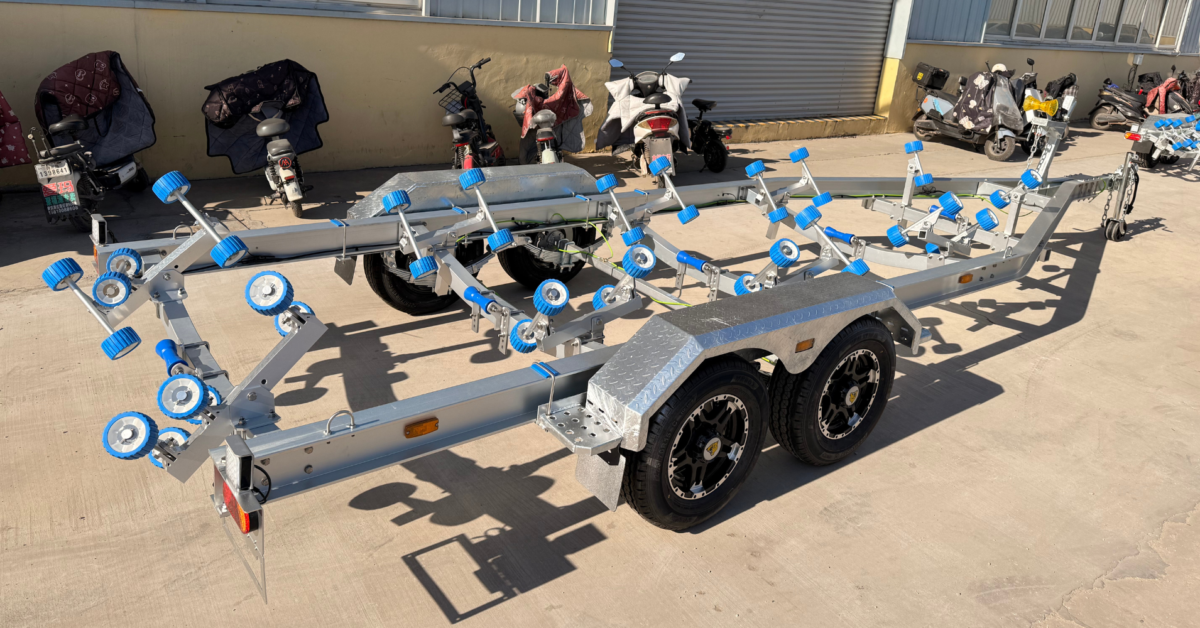
How Many Axles Do I Need? Start With Loaded Weight, Not Length
The axle count a boat trailer needs is set by the fully loaded weight of the rig — hull, engine, fuel, water, batteries and gear — not by the length printed in the brochure.
Length is a useful proxy because longer boats usually weigh more, but two boats of the same length can land in different brackets: a bare aluminum tiller boat with a small outboard is not the same load as a deep-V glass hull with a large four-stroke and a full tank.
That load is the wet weight, and the consumables are heavier than most owners expect. Gasoline weighs 6.3 lb per US gallon, diesel about 7.15 lb, fresh water about 8.34 lb, and a marine battery 40–70 lb.
Length overall (LOA) cannot substitute for it: the printed figure includes outboards, brackets and swim platforms, while a trailer supports only the part of the hull below the waterline. The boat trailer size chart covers the length question; for weight, you compare against the trailer’s GVWR, where payload capacity is GVWR minus tare weight. A single-axle trailer typically weighs 400–800 lb empty and a tandem 800–1,500 lb — the comparison is set out in boat trailer weight capacity.
As rough orientation, a 16 ft aluminum rig commonly lands at 1,500–2,500 lb loaded, a 20 ft fiberglass boat at 3,000–4,500 lb, and a 24 ft boat at 5,000–7,500 lb. Those are general market ranges, so weigh your own rig.
Single vs Tandem vs Tri-Axle: The Comparison
Single-axle trailers put the whole load on two tires, tandem-axle trailers spread it across four, and tri-axle trailers spread it across six — and almost every other difference follows from that one fact.
| Configuration | Best fit | Tires | Bearing sets | Brake units | Maneuvering | Highway stability | Blowout margin | Maintenance |
|---|---|---|---|---|---|---|---|---|
| Single axle | Under 20 ft and 3,500 lb; New Zealand guidance: under 5 m | 2 | 2 | 2 if braked | Best — pushable and pivotable by hand | Adequate; sensitive to light tongue weight | None — a failure stops the tow | Lowest |
| Tandem axle | 21 ft and up, or heavier fiberglass hulls | 4 | 4 | 4 if braked | Wider circle; not hand-movable loaded | Clearly better at highway speed | Three tires still carry the load | About twice a single axle |
| Tri-axle | Long, heavy hulls beyond tandem capacity | 6 | 6 | 6 if braked | Largest circle, most tire scrub | Highest, but not a reason to buy one | Five tires still carry the load | Six tires, six bearing sets |
Single Axle: The Right Answer Under 20 ft and 3,500 lb
A single-axle trailer is the correct configuration for boats up to roughly 20 ft and 3,500 lb, and New Zealand guidance draws the same practical line at 5 m.
Its advantages are simplicity and weight. It is the lightest option on the road, so an unloaded trailer can be pushed and pivoted by hand, and the parts count is minimal — one pair of tires, two bearing sets, two brake assemblies if braked — which keeps purchase and service cost down.
The limits are real. There is no redundancy: if a tire or bearing fails, the trailer stops where it is, and the whole load rides on two contact patches, so load placement, tongue weight and tire pressure matter more than on a tandem.
Tandem Axle: Four Benefits You Can Feel on the Road
A tandem axle earns its place once the loaded weight or the highway mileage passes what two tires should carry, which is why 21 ft boats and heavier fiberglass hulls ride on four.
1. The load is divided across four tires instead of two
A trailer running ST205/75R14 load range C tires carries 1,760 lb per tire at 50 PSI, so four tires carry 7,040 lb where two carry 3,520 lb — the difference between running at 80–85% of the rating and running at the edge.
2. Highway stability improves noticeably
Four contact points instead of two make the trailer far less likely to be upset by one wheel dropping off the pavement edge, a crosswind gust, or the air wake of a passing truck. On a long tow, this is the most obvious difference between a single and a tandem.
3. A blowout stops being a roadside emergency
If one tire fails on a tandem, the remaining three still carry the load, so you can slow down and reach the next exit instead of stopping in a live traffic lane. Trailer tires are the most likely component to fail: they sit for months, age faster than they wear, and are often run under-inflated.
4. Axle load is shared more evenly, which is friendlier to the hull
Spreading the same weight over two axles lowers the load each frame member and hull contact point has to carry, and the extra suspension travel absorbs more of the road. The benefit appears later on: less fatigue at hull contact areas and at the fasteners holding the support structure.
The trade-offs are equally concrete: a wider turning arc, more tire scrub, roughly twice the parts to service, and a trailer you cannot push by hand once loaded. Ten minutes to a local lake makes those real; three hours to the coast makes them trivial.
Tri-Axle: A Weight Solution, Not a Stability Upgrade
A tri-axle is justified when the loaded rig genuinely exceeds what four tires should carry, and choosing one because six tires look more stable makes the whole setup worse.
Adding an axle only helps if the frame, axles, suspension, brakes and coupling are all rated for the result. On a rig that already fits a tandem rating with 15–20% margin, a third axle adds tare weight — reducing payload for the same GVWR — plus a larger turning circle, more tire scrub, six tires and six bearing sets to maintain, and a heavier tow vehicle.
So buy a tri-axle when the scale says you need one, and not before. Tracking and blowout margin are side effects of carrying weight properly, never a reason on their own.
What Overloading a Single Axle Actually Costs You
Overloading a single axle produces one of three failures — a blown tire, an overheated wheel bearing, or a high-speed instability event — and none gives much warning.
Tire failure is the most frequent, and it is a pressure problem as much as a load problem. An ST175/80R13 load range C tire rated at 1,360 lb at 50 PSI drops to 1,190 lb at 40 PSI — 170 lb lost per tire, simply from running a little soft. Inflate to the maximum cold pressure on the sidewall, not the 35–38 PSI a passenger car uses, and never bleed a hot tire: a 4–8 PSI rise after highway running is normal.
Bearing failure follows the same logic: an overloaded or under-lubricated hub bearing runs hot, the grease breaks down, and the failure usually takes the spindle and hub with it. Often the only warning is a warm hub at a fuel stop.
Instability is usually a tongue weight problem rather than an axle problem. Boat trailers need 5–10% of the total rig weight on the tongue, and most manufacturers recommend 7–10%; the familiar 10–15% figure belongs to cargo and RV trailers, because a boat’s mass sits low and toward the stern. Too little tongue weight causes sway; too much overloads the tow vehicle’s rear axle and lengthens stopping distances. Tongue weight counts against the vehicle’s payload, never its towing capacity.
Brakes: The Trigger Is Weight, Not Axle Count
Brake requirements follow weight and jurisdiction rather than axle count, though each axle you add also adds a pair of brake assemblies.
In the United States, 49 CFR 393.42 allows a trailer with a gross weight of 3,000 lb (1,361 kg) or less to be exempt, but only if a second condition also holds: the trailer’s axle weight must not exceed 40% of the total axle weight of the towing vehicle. Both conditions must be met at the same time.
One qualification matters more than the numbers. 49 CFR Part 393 governs commercial motor vehicles, while a private non-commercial boat trailer is mainly regulated by state law — confirm the rule with your state motor vehicle authority. California, for example, requires brakes on trailers over 3,000 lb gross.
Where brakes are fitted, 49 CFR 393.48(d) permits surge brakes up to a GVWR of 12,000 lb provided it does not exceed 1.75 times the towing vehicle’s GVWR, and from 12,000 to 20,000 lb provided it does not exceed 1.25 times, while 49 CFR 393.43(d) requires a braked trailer to apply its brakes automatically and hold for at least 15 minutes if it separates. Elsewhere the classes differ: under the EU’s Regulation (EU) 2018/858, trailers run from O1 up to 0.75 t and O2 above 0.75 to 3.5 t to O3 above 3.5 to 10 t and O4 above 10 t, with braking mandatory from O2, and Australia’s RVSA 2018 sets a low ATM trailer at 4.5 t or less, where ATM equals GTM plus tongue mass.
Maintenance: The Parts Count Doubles, Then Triples
Maintenance cost tracks the number of tires, hubs and brake assemblies, so it roughly doubles from a single axle to a tandem and triples from a single to a tri-axle.
| Configuration | Tires to replace | Hubs / bearing sets | Brake assemblies | Relative parts count |
|---|---|---|---|---|
| Single axle | 2 | 2 | 2 if braked | 1× |
| Tandem axle | 4 | 4 | 4 if braked | About 2× |
| Tri-axle | 6 | 6 | 6 if braked | About 3× |
The cost is not only in parts: every hub needs greasing and inspection, and every brake assembly needs its shoes, drums or calipers checked.
Trailer tires also age out before they wear out. Common guidance is replacement at 3–5 years with 6 years as a hard limit, even when no cracks are visible; tread below 2/32 inch means replacement, and sidewall cracks that open under pressure or expose cord mean the tire is finished. The four-digit DOT code gives the build date, so 2523 means the 25th week of 2023 — and a tri-axle owner buys six of those on the calendar.
How to Choose Your Axle Count: Five Steps
- Weigh the rig loaded. Fuel it, load the gear, put the boat on the trailer and take it to a scale — do not estimate.
- Read the trailer’s ratings. Find the GVWR and GAWR on the certification label and the tare weight, then work out payload capacity as GVWR minus tare weight.
- Leave 15–20% margin. The loaded weight should sit at 80–85% of rated capacity, because fuel, water and gear always weigh more than expected.
- Choose the axle count. Under about 20 ft and 3,500 lb a single axle is right; at 21 ft or with a heavier fiberglass hull, go to a tandem; move to a tri-axle only when the scale says four tires cannot carry the load with margin.
- Re-check the tow vehicle. Tongue weight should be 5–10% of the total, most manufacturers recommend 7–10%, and it counts against the vehicle’s payload. Keep the rig at or below 80% of the tow rating.
Once the axle count is settled, the next decision is how the trailer supports the hull — covered in bunk vs roller boat trailer.
Frequently Asked Questions
How many axles do I need for a 20 foot boat?
A 20 ft boat sits right at the boundary. If the loaded weight is under about 3,500 lb, a single axle is the minimum and will work. If it is a glass hull with a large outboard, a full fuel load, batteries and gear, the rig will usually reach 4,000 lb or more and a tandem is the safer choice.
Is a tandem axle boat trailer better than a single axle?
Above roughly 3,500 lb or 21 ft, yes: it lowers the load per tire, improves highway stability and keeps three tires carrying the load if one fails. Below that weight it is heavier, wider-turning and more expensive to maintain than it needs to be.
What happens if I overload a single axle boat trailer?
The three typical outcomes are a blown tire, a wheel bearing that overheats and fails, and high-speed sway. All three come from running out of capacity or margin, and all three are more likely on a hot day at highway speed.
Do I need brakes on a boat trailer?
It depends on weight and where you tow. Under 49 CFR 393.42, a trailer of 3,000 lb (1,361 kg) or less may be exempt only if its axle weight is also not more than 40% of the towing vehicle’s total axle weight — both conditions must be met. Note that 49 CFR Part 393 governs commercial motor vehicles and private non-commercial trailers are mainly covered by state law, so confirm the threshold with your state authority.
Is a tri-axle boat trailer more stable?
Yes — six tires track better and give the largest blowout margin — but that is not a good reason to buy one. A tri-axle adds tare weight, turning radius and maintenance for the same GVWR. Choose it when the loaded weight genuinely exceeds what four tires should carry with 15–20% margin.
What tongue weight should a boat trailer have?
Between 5% and 10% of the total rig weight, with most manufacturers recommending 7–10%. The 10–15% figure quoted online applies to cargo and RV trailers, not boats, because a boat’s mass sits lower and further aft.
If you know the boat, the engine and the gear you carry, the axle count follows from the weight. Tell us what you tow and where, and we will help match the configuration to the load. See the full boat trailer range, including hot-dip galvanized boat trailers built for saltwater ramps, or contact us for a trailer quote.