
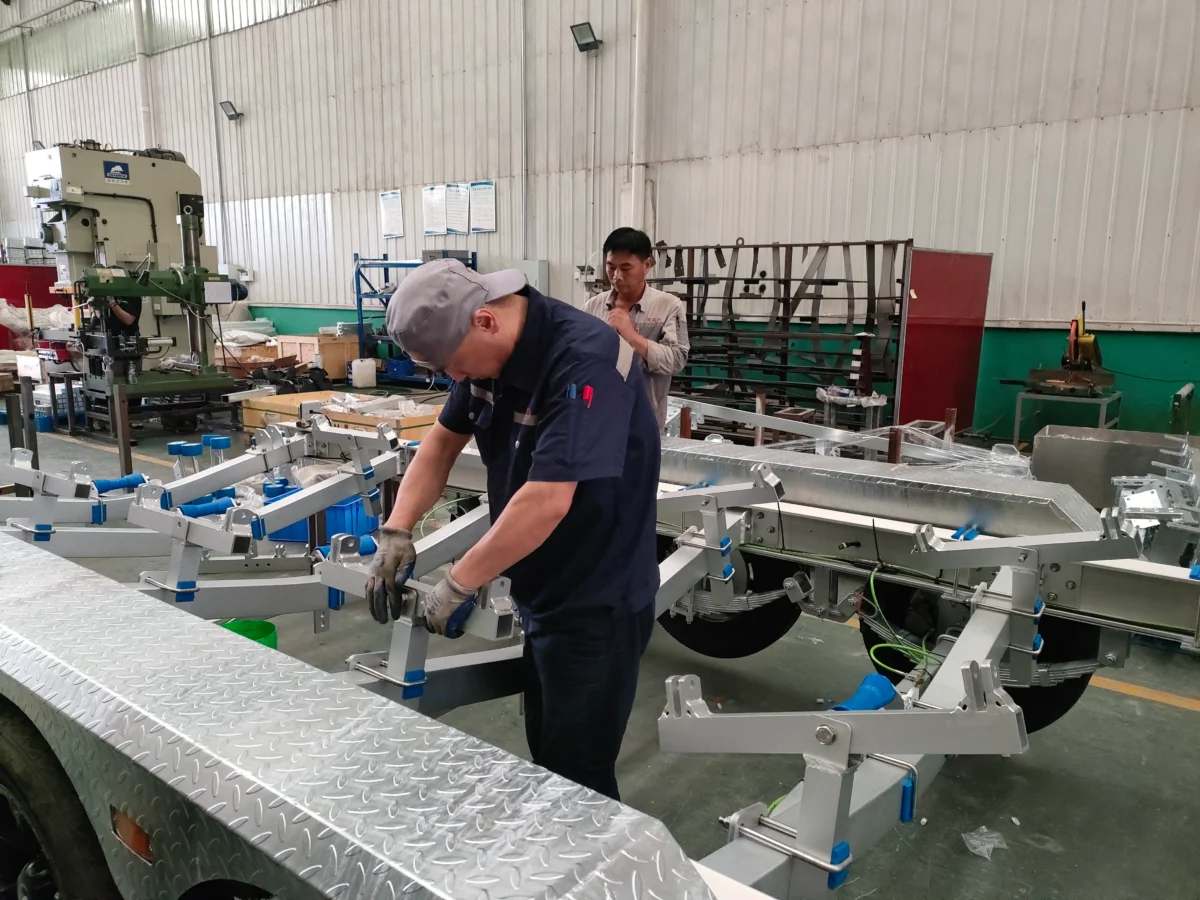
A custom boat trailer order is a controlled engineering project: hull data becomes a design proposal, the signed drawing freezes the specification, a first article is confirmed against the drawing and a real boat, and only then does production start. We cannot quote from a model name alone — we need dimensions, weights, weight distribution and the destination market’s rules. Every later change goes back to the drawing.
This is the order and project workflow from enquiry to production, not how to audit or choose a factory (a separate importer’s guide) and not container loading optimization.
The hull data a builder needs before quoting
Hull data, not a boat model name, is what a builder quotes from. A model name gives the boat family but not the axle position, frame width or rated capacity. Each input below changes the design.
- Length overall (LOA). LOA sets trailer length and the bow stop and winch post position. The aft overhang decides how far bunks or rollers must run, which lengthens the frame and moves the axle group to keep the load balanced.
- Beam. Beam fixes bunk or roller spacing, overall width and the beam allowance — clearance between the widest hull point and the frame. It also meets the destination width limit: in the US the federal interstate limit is 8.5 ft (102 in), so a wide hull can force a narrower support arrangement.
- Dry hull weight. This is the base load for the frame, axles, suspension, tires and coupling, and it feeds the rated capacity with the engine, fluids and gear.
- Engine weight. Outboard or stern drive mass sits aft of the transom, so it shifts the center of gravity aft, changing axle position and tongue weight. A heavier engine can move the axle group aft or require a different support layout.
- Fuel and water capacity. Full tanks add weight often left out of an early enquiry. The trailer is rated for the boat in service condition, not an empty hull, so these capacities belong in the specification.
- Batteries and gear. These are concentrated, fixed loads; their location matters as much as their mass, because a forward or aft battery bank shifts the center of gravity.
- Center of gravity or weight distribution notes. This drives axle placement and the tongue weight target, commonly 5-10% of GTW for boat trailers (most builders work to 7-10%). The figure comes from geometry and axle position, not added ballast.
- Axle preference. Single or tandem changes frame loads, support spacing, brake configuration and ride. It has to be reconciled with the rated load and the market’s braking rules, not copied from another model.
- Target market and its regulations. Braking, lighting, width, coupling and documentation differ by destination, so the market is an input to the first quote; confirm its current requirements with the relevant authority or your notified body.
Send these as a written specification, marking which values are confirmed and which are estimates. An estimated beam or unconfirmed engine can support a preliminary proposal, but the assumption must be stated so it can be checked rather than discovered in the finished batch.
From enquiry to a design proposal
A design proposal is an engineering proposal, not a catalogue pick. Hull data is converted into geometry and ratings, and the output is a documented configuration the buyer can approve or correct before material is cut.
| Hull data supplied | What it drives on the trailer |
|---|---|
| LOA and transom overhang | Overall length, frame length, bow stop and winch post position |
| Beam | Bunk or roller spacing, overall width, beam allowance, width compliance |
| Hull, engine, fluid and gear weight | Rated capacity, axle, tire, suspension and coupling ratings, frame section |
| Center of gravity and weight distribution | Axle position and count, tongue weight target |
| Bottom shape, keel, strakes and steps | Bunk angle, roller count and placement, support layout |
| Axle preference | Axle count, suspension and brake layout |
| Target market | Braking, lighting, coupling, ball size, finish and documentation |
The proposal states trailer length, beam allowance, axle position and count, bunk or roller layout, frame section and rated capacity, plus finish, coupling and ball size and the market’s braking and lighting configuration. Rated capacity is not the sum of component ratings: the whole trailer is governed by its weakest link, as covered in our explanation of how boat trailer GVWR is determined.
Mark up the proposal rather than accepting it silently: questions about support contact, winch post height or brake specification are cheaper to resolve here than on a completed frame.
Drawing approval is the real control point
The signed drawing is the real control point of a custom order: it is what production, inspection and any repeat order are measured against.
Approval is not a formality: a signature accepts the geometry, ratings and market configuration as the definition of the product. These items must be frozen, with a drawing number and revision field, before tooling and purchasing start.
| Item frozen on the signed drawing | Why it is fixed before tooling |
|---|---|
| Overall length and width | Sets frame stock, transport width and width compliance |
| Axle position and count | Sets load distribution, tongue weight and the bending load path; hard to correct after welding |
| Support layout (bunk or roller) | Fixes bracket positions and contact pattern against the bottom shape |
| Bow stop and winch post | Fixes the hull’s forward location, loading angle and tie-down geometry |
| Tongue weight target | Confirms the balance assumption the axle position was calculated from |
| GVWR and axle ratings | Locks component selection, the rating plate and market documentation |
| Braking and lighting configuration for the destination market | Market-specific components and wiring cannot be swapped at dispatch |
| Finish | Decides the coating or galvanizing route and hardware materials |
| Coupling and ball size | Must match the tow vehicles and market coupling requirements |
Once signed, the drawing is the reference. Any later deviation is handled as a revision, and the revision history is what makes a second order reproducible.
First article / prototype confirmation
The first article is checked against the signed drawing and against a real boat. It proves that the design, as drawn, supports the hull it was designed for — something a frame dimension check cannot do.
The checks are process checks. Fit is assessed with the hull in place: the bow stop locates the boat, the winch post and tie-downs line up, and the hull centers on the frame. The bunk or roller contact pattern is read against the bottom shape, with support on designed load areas rather than strakes, steps or a thin hull section. Centering and tongue weight are checked against the drawing, and lighting and braking are function-checked with the market configuration.
Where a boat is available, fit and contact pattern are checked against the hull itself; otherwise they are checked against the confirmed hull data and the drawing, with estimates recorded. The output is a first-article confirmation record listing what was checked, what was accepted and which deviations were raised against a revision.
Change control after approval
Any change after approval must return to the drawing and be re-signed. A new engine, a revised hull weight, a different market or a switch from bunks to rollers changes geometry, ratings or compliance.
Verbal changes are the most common source of a batch that does not fit: one department acts on a call while purchasing, welding and inspection work from the older revision, so the frame, parts list and paperwork each follow a different layout.
A simple change record prevents this. It should contain:
- A record number, the date, who raised it and who approved it.
- The drawing number, the revision superseded and the new revision.
- The fields changed, written as before and after values.
- The reason and the affected area: hull data, engine, market, support layout, ratings or finish.
- Whether the first article must be re-confirmed against the revised drawing.
- The point at which the change takes effect, and which documents are reissued.
A change record lets buyer, builder and inspection body agree which revision a unit belongs to.
Market compliance is a design input, not a later add-on
Market compliance is a design input, not a later add-on. Braking, lighting, width, coupling and documentation are fixed by where the trailer will be registered, so the destination market is settled before the drawing is signed.
| Market | Design inputs affected | Approval and documentation route |
|---|---|---|
| United States | Braking thresholds, lighting, 8.5 ft (102 in) width, coupling and identification | 49 CFR 393.42 sets a brake exemption at or below 3,000 lb (1,361 kg), also requiring the trailer axle weight not exceed 40% of the sum of the tow vehicle’s axle weights; documentation commonly includes the commercial invoice, bill of lading, ISF, importer of record, and HS heading 8716 in Chapter 87 |
| European Union | Braking, lighting, width, coupling and the type-approved configuration | Type approval with a CoC / Declaration of Conformity under Regulation (EU) 2018/858; see our CE and WVTA type approval guide |
| Australia | Braking, lighting, dimensions and approved configuration | RAV and ROVER entries under the RVSA, with approval and registration documentation tied to that entry |
| New Zealand | Entry, dimensions, lighting and registration requirements | Separate entry and registration requirements; confirm the current requirements with the relevant authority or your notified body |
These are not interchangeable labels: a trailer configured for one market cannot be assumed to satisfy another by changing a connector. Hyroad Trailer holds ISO, WMI, CE, US DOT, EU WVTA and Australian VTA certifications; confirm the current requirements with the relevant authority or your notified body.
A change of market after approval is a design change and goes through the change record, and compliance fields belong on the signed drawing alongside the dimensions.
Production and the handoff to pre-shipment inspection
Production starts from the frozen drawing, not from the quotation. Purchasing, cutting, welding, finishing and assembly follow the signed revision, and material and mill certificates are collected during the run so units can be traced to the specified stock.
Batch production is handed to pre-shipment inspection, where the agreed checks are applied before dispatch.
Container loading and space planning are a separate discipline, covered in our guide to shipping boat trailers overseas.
The handoff is documentary too: the inspection body works from the signed drawing, specification sheet and confirmed revision.
What the buyer should keep on file
The buyer should keep the full project record, not just the commercial invoice. A repeat order, spare parts request or warranty discussion is only as fast as the documents behind it.
- The signed drawing and its complete revision history, including every change record.
- The specification sheet: hull data as confirmed, with the assumptions used for estimates.
- Material certificates, including mill certificates and the ISO 1461 galvanizing certificate where specified.
- Conformity documents for the destination market — CoC / Declaration of Conformity under Regulation (EU) 2018/858 or RAV / ROVER entries — with the commercial invoice, bill of lading, ISF, importer of record record and HS 8716 classification.
- The first-article confirmation record, with deviations and the revision they were closed against.
- The inspection report issued before shipment.
Index these by drawing revision rather than order date: two orders can share a model name and differ in support layout, braking or finish.
Frequently Asked Questions
These are the questions that decide whether a custom order runs cleanly.
What information do I need to order a custom boat trailer?
You need LOA, beam, dry hull weight, engine weight, fuel and water capacity, batteries and gear, center of gravity or weight distribution notes, axle preference, and the target market with its regulations. Send them as a written specification and mark which values are confirmed and which are estimates. Those inputs determine trailer length, beam allowance, axle position, support layout, frame section and rated capacity.
Can a trailer be built for a boat I have not delivered yet?
Yes, provided the hull data is confirmed by the boat builder in writing and the remaining unknowns are recorded as assumptions on the proposal and the drawing. The design work can proceed from confirmed hull data, but the first-article fit check against a real boat can only happen once a hull is available, or against the confirmed data if it is not. Record that limitation in the first-article confirmation record.
Do I need type approval for a custom trailer?
It depends on the destination market. In the EU the route is type approval with a CoC / Declaration of Conformity under Regulation (EU) 2018/858; in Australia it is RAV and ROVER under the RVSA; other markets apply their own rules. Confirm the current requirements with the relevant authority or your notified body before the drawing is signed, because approval is part of the design configuration, not a document added later.
What should be frozen on the signed drawing?
Freeze overall length and width, axle position and count, support layout, bow stop and winch post, tongue weight target, GVWR and axle ratings, the braking and lighting configuration for the destination market, finish, and coupling and ball size. Each item needs a drawing number and revision field. The signed drawing is then the reference for the first article, production and inspection.
What happens if I change the engine after approval?
The change returns to the drawing and is re-signed. A different engine weight shifts the center of gravity, so axle position, tongue weight and possibly the support layout and rated capacity have to be recalculated, and the first article may need to be re-confirmed. Put the change in a change record with before and after values rather than passing it on verbally.
Who checks the first article before production?
The builder checks the first unit against the signed drawing, and the fit and contact pattern are checked against a real boat where one is available; the buyer or a nominated inspection body can witness or review that confirmation. The output is a written first-article confirmation record. Third-party inspection, where used, is appointed by the buyer or agreed between both parties.
If you are planning a custom boat trailer order, start with the hull data and the destination market rather than a catalogue page. Send the specification to our engineering team and we will return a design proposal and a drawing for approval. Use the contact page to open the conversation.