
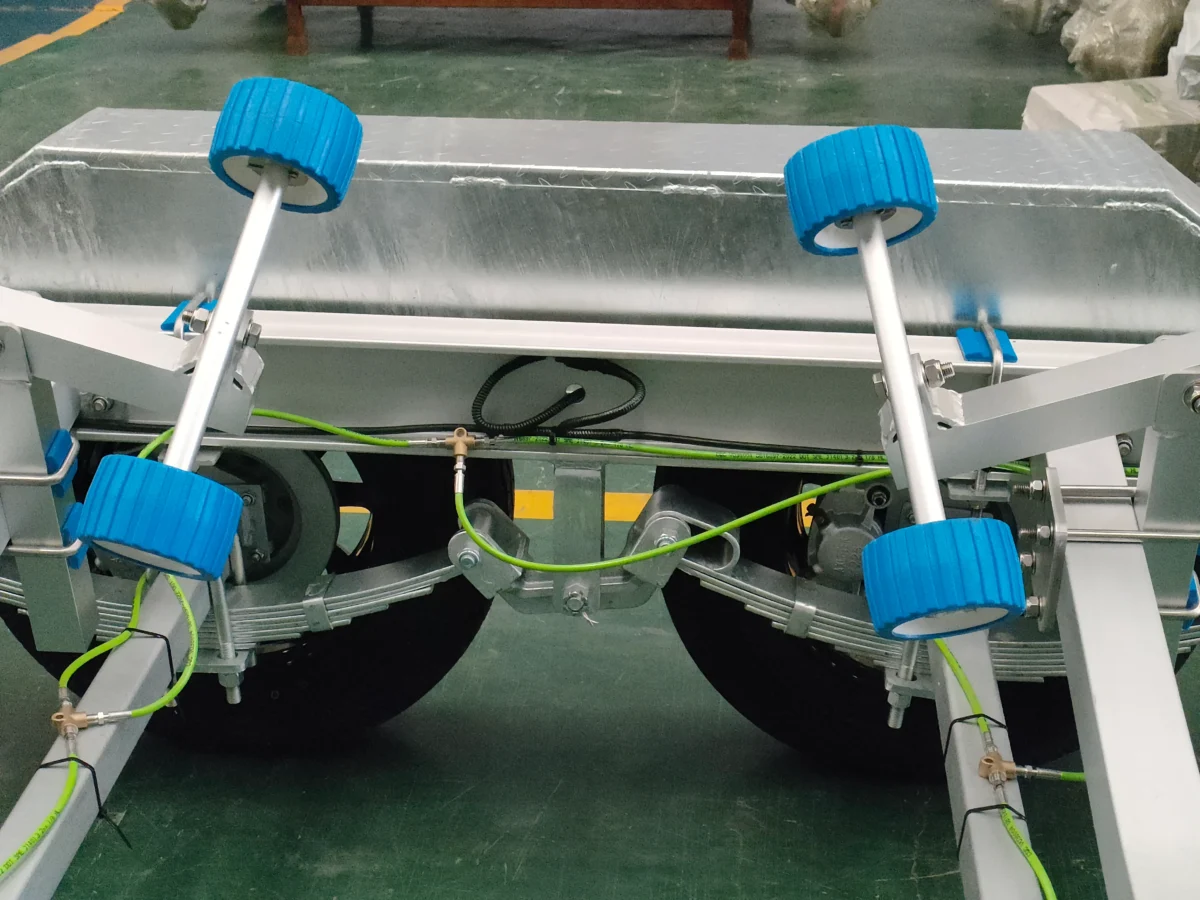
A boat trailer GVWR is a rating the manufacturer declares for the whole assembly, and it is governed by the weakest link — axle, tires, suspension, frame or coupler — not by adding up part ratings. The frame has to survive static load plus dynamic amplification, cyclic fatigue and tongue weight. The applicable design code and the manufacturer’s validation testing govern; confirm the figure with the manufacturer.
This article deals with the manufacturer-side question of where a declared boat trailer GVWR comes from and what the frame has to survive; it is not a buyer-side calculator for how much capacity you need.
GVWR Is a Declared Rating, Not a Sum of Parts
GVWR is a single number the manufacturer declares for the complete trailer, and it is governed by the weakest link in the assembly rather than by any addition. It is not obtained by adding axle, tire and coupler ratings together; it is a declared ceiling, and the lowest-rated component sets it. If the axles outrate the tires, the tires govern; if the frame outrates the coupler, the coupler governs.
For an importer this is the useful test. When a supplier offers a heavier frame as a route to a higher GVWR, ask which component was the limiting link. If it was the axle, suspension or coupler, a heavier main rail leaves the declared rating exactly where it was. The table below maps the components that can cap the assembly.
| Component | What it contributes | Why it can be the limiting link |
|---|---|---|
| Axle | Its own rated capacity | A heavier frame does not change the axle’s declared rating |
| Tires | Load rating at the specified inflation | Tire ratings cap the assembly regardless of beam size |
| Suspension | Spring or torsion unit rating | An undersized suspension governs well before the frame yields |
| Frame | Bending, torsion and fatigue capacity | Deflection and detail fatigue, not just ultimate strength, can govern |
| Coupler | Its rated capacity | The coupler sees tongue load and towing force, a different load case |
A declared rating has to be engineered as a system: every link must support the higher number, and the rating plate and documents must be reissued.
Static Load and Dynamic Load Are Different Problems
Static load and dynamic load are two different engineering problems, and a frame that survives one will not automatically survive the other. Static load is tare weight plus payload at rest: a steady bending case in which the hull presses through the crossmembers into the main rails and the axles react it back. It can be checked against strength and deflection with relatively little ambiguity.
Dynamic loading is what the frame sees in motion. Road shock, ramp transitions, braking and curb strikes superimpose short-duration inputs on the static case, amplified by the response of the trailer and its suspension. Repeated over a service life those inputs become cyclic loading, the domain of fatigue rather than single-event strength. A beam can look comfortable in static bending and still accumulate damage where stress cycles concentrate.
| Load case | What it is | Where it acts on a boat trailer |
|---|---|---|
| Static | Tare weight plus payload at rest | Main rails in sustained bending; axles and tires in constant compression |
| Road shock and ramp transitions | Short-duration vertical input from uneven surfaces and launch ramps | Drawbar, spring hangers and crossmember intersections |
| Braking and curb strikes | Fore-aft and lateral inputs | Coupler, drawbar, gusset ends and bracket edges |
| Cyclic loading | Repeated stress over the service life | Weld toes, holes and section changes, where fatigue initiates |
We put no multiplier on any of these cases. The applicable design code and the manufacturer’s validation testing govern; confirm the figure with the manufacturer. Any dynamic factor, safety factor, fatigue life or stress result quoted without that context does not belong in a purchase specification.
Bending and Torsion Load Paths
A trailer frame carries load through two separate paths: vertical bending along the main rails and torsion across the width of the frame. The rails resist the downward bending of the hull between axle and tongue; crossmembers tie them together and gussets stiffen the joints so the frame resists twisting when one wheel climbs a ramp. Both paths must be continuous — a strong rail with weak crossmembers bends little but twists badly.
Where geometry changes, stress concentrates. Holes for wiring, sudden section changes, squared bracket ends and gusset terminations all interrupt a smooth load path, so local stress is higher than a nominal section calculation suggests. The choice of rail section form, whether an I-beam or a channel, is a separate design discussion covered in our guide to boat trailer frame design.
For an importer the review point is continuity rather than raw section size: trace the load from bunks to rails to axles and coupler, and look for abrupt interruptions, convergences and hard terminations.
Fatigue Starts at Details, Not in the Middle of a Beam
Fatigue cracking in a welded trailer frame starts at details, not in the uninterrupted middle of a main rail. Weld toes, rail-to-crossmember intersections, gusset ends and bracket edges are where stiffness changes abruptly and the load path turns a corner, so local stress cycles are higher than in the plain span. A crack near a gusset end usually says something about geometry and load path, not simply about how the bead was laid down.
That matters when a batch shows a repeating crack: rewelding to a higher visual standard will not help if the cause is a hard termination concentrating stress. The fix is a geometry change — a tapered gusset end, a radiused bracket, a relocated intersection. Weld acceptance levels and inspection are their own subject; see our guide to boat trailer weld quality and inspection.
Corrosion and wear also reduce effective thickness over time, which is why a corrosion allowance belongs in the design discussion rather than being treated as a finishing choice. Where a figure for remaining margin is needed, the applicable design code and the manufacturer’s validation testing govern; confirm the figure with the manufacturer.
Tongue Weight Belongs in the Load Case
Tongue weight is a permanent part of the trailer’s load case, not a handling detail left to the tow vehicle. For a boat trailer, tongue weight is 5–10% of GTW, and most makers recommend 7–10%. That downward force at the coupler is carried by the drawbar and front frame every time the trailer is hitched and is part of the static equilibrium of the assembly. A design that considers only the load between the axles has an incomplete load case.
Tongue weight counts against the tow vehicle’s payload, not its towing capacity — two different limits that are often confused. For the manufacturer, the drawbar and coupler zone sees a different load pattern from the mid-frame: a concentrated vertical force at the ball plus fore-aft towing and braking forces, rather than distributed bending under the hull. The gussets and drawbar-to-rail junction are where those paths meet.
A change that shifts mass forward can move tongue weight within or beyond the recommended band. For more on how it is set and checked, see our guide to boat trailer tongue weight; here it is enough to treat it as a fixed part of the load case.
Why Simply Thickening the Main Beam Is Not the Answer
Making the main beam thicker does not, by itself, raise a declared GVWR. It addresses only one part of a system rating and introduces effects that must be designed around. Stiffness and deflection do improve with a deeper or heavier section, but stiffness is not strength, and neither changes the rating of the axle, tires, suspension or coupler. If one of those is the limiting link, the declared GVWR is unchanged.
There are secondary costs. Extra steel adds tare weight, reducing payload under a given GVWR; mass added forward of the axles shifts tongue weight; a deeper section changes the geometry that must fit the galvanizing bath and bracketry; and a thicker member still needs a corrosion allowance because section loss erodes the margin over time.
| Change | Intended gain | What it actually shifts |
|---|---|---|
| A heavier or deeper main rail | More bending strength and stiffness, less deflection | Adds tare weight, shifts tongue weight, changes section geometry and galvanizing bath fit; the axle or coupler can still govern |
| Additional crossmembers | More lateral rigidity and torsion resistance | Introduces more rail-to-crossmember intersections and weld toes, which are fatigue initiation sites |
| Larger gussets at the drawbar | A stiffer joint | Moves the stress concentration to the gusset end instead of removing it |
| Upgrading only one component, such as the axle or coupler | Raises that component’s rating | GVWR rises only if that part was the actual limiting link; tires, suspension and the rating plate must follow |
| Extra thickness with no corrosion allowance | More initial section | Long-term section loss from corrosion and wear still reduces the effective margin |
Read the third column first. Every change buys something and moves something else, so a rating change has to be closed out across the whole assembly and re-documented on the plate. The applicable design code and the manufacturer’s validation testing govern; confirm the figure with the manufacturer.
What Validation Actually Looks Like
A declared GVWR is supported by categories of validation, not by a single calculation. The rating is backed by a program that checks the assembled trailer against the way it will actually be loaded.
- Static load testing. The loaded trailer is held at its rated condition while deflection, clearances and permanent set are observed.
- Road durability testing. The unit is run over representative surfaces so dynamic inputs and cyclic loading are applied to the real structure.
- Braking and towing tests. Fore-aft forces, coupler loads and the behavior of the combination under braking are checked.
- Dimensional and weld inspection. The built frame is compared with the drawing, and welds are examined against the specified acceptance level.
- Rating-plate consistency. GVWR and GAWR on the plate are reconciled with the component ratings and the approval documents.
These are categories, not a protocol with figures attached. Which tests apply, to what level and for how long is a matter for the applicable design code and the manufacturer’s validation program; confirm the figure with the manufacturer. When a supplier claims validation, ask which categories were covered and how the declared rating follows from them.
What to Ask a Manufacturer For
An importer can judge the credibility of a declared GVWR by asking a short list of questions; the answers are more informative than any single section dimension. The goal is to see whether the rating was engineered as a system and whether the paperwork will survive a registration check.
- The basis of the declared GVWR. Ask which component is the limiting link and how the rating was arrived at.
- Axle and tire ratings as fitted. Request the ratings for the actual units on the trailer, not a catalog range.
- Frame material grade and thickness band. Ask which grade is used and which thickness band applies to rails and crossmembers.
- Weld acceptance level. Ask which level the frame is built and inspected to, and how that is verified.
- Rating plate and CoC consistency. Confirm GVWR, GAWR, VIN and model agree across the plate and approval documents; our guide to the boat trailer VIN and rating plate covers those fields.
- A validation summary. Ask which categories of testing and inspection back this model’s declared rating.
How a supplier answers is itself part of the assessment: one that can name the limiting link, the fitted component ratings and the document reconciliation is showing the engineering behind the number. For a broader framework, see our guide to choosing a boat trailer manufacturer for importers. Confirm the current requirements with the relevant authority where a question turns on a legal or code interpretation.
Frequently Asked Questions
Who determines a trailer’s GVWR?
The manufacturer determines and declares a trailer’s GVWR. It is the rating for the complete assembly, governed by the weakest link among the axles, tires, suspension, frame and coupler, not by adding up part ratings. The applicable design code and the manufacturer’s validation testing govern; confirm the figure with the manufacturer.
Can I increase my boat trailer’s GVWR?
Not by changing the number on the plate. GVWR is a declared rating tied to the weakest component, so raising it requires that the limiting axle, tires, suspension, frame and coupler all support the higher value, and that the rating plate and documents are reissued. Ask the manufacturer whether a higher declared rating is available for that model.
Is GVWR the same as payload capacity?
No. GVWR is the maximum permitted weight of the fully loaded trailer. Payload capacity is what remains after subtracting the trailer’s own tare weight, and it is a derived figure rather than the declared rating. For a manufacturer, the declared GVWR is set by the weakest link in the assembly.
Does a heavier frame increase GVWR?
Not on its own. A heavier beam adds bending strength and stiffness, but the assembly rating is still governed by the weakest link, which may be the axle, tires, suspension or coupler. It also adds tare weight and can shift tongue weight. Confirm the figure with the manufacturer.
What does GAWR mean on a trailer?
GAWR is the gross axle weight rating, the maximum load a given axle is rated to carry. It appears on the certification label alongside GVWR. On an import file, the GAWR values on the plate, in the CoC where applicable and in the order specification must agree.
Is GVWR the same as towing capacity?
No. GVWR is a rating of the trailer itself, while towing capacity is a rating of the tow vehicle. Tongue weight, which for a boat trailer is 5 to 10 percent of GTW with most makers recommending 7 to 10 percent, counts against the tow vehicle’s payload rather than its towing capacity. Keep the two separate when checking a combination.
GVWR is settled on the drawing and in validation, long before a unit is crated. If you are specifying boat trailers for import and want to agree the declared ratings, frame section and document set up front, contact us to discuss your requirements.