
A boat trailer VIN is a 17-character identifier governed in the US by 49 CFR Part 565, with a check digit in position 9 and no repeats within 60 years. The VIN is not the certification label, which falls under 49 CFR Part 567. The rating plate, CoC, commercial invoice and physical unit must all agree, and EU and Australian markets do not follow this US rule.
What 49 CFR Part 565 Actually Requires
49 CFR Part 565 fixes the US VIN at exactly 17 characters and sets the rules that make it a durable, checkable identifier. It governs the identifier, not the trailer’s weight ratings. A unit that arrives with 16 characters, a blank position or a peel-off label is already wrong before any document is opened.
The requirements that matter at intake:
- Length and completeness. 17 characters, every position filled; no blanks or shortened codes.
- Character set. Capital letters and numerals only, excluding I, O and Q to avoid confusion with 1 and 0; rendered in a capital, sans-serif face.
- Check digit. Position 9, calculated by the weighted method in §565.15 and expressed as 0 through 9 or X; it catches transcription errors.
- No reuse. No VIN may repeat within a 60-year period beginning with model year 1980.
- Permanence. Clear and indelible, on a part not designed to be removed or on a permanently affixed plate or label.
Part 565 also obliges the manufacturer to file the information that lets anyone decode its VINs. Confirm the current text of the regulation with the relevant authority before treating any summary as complete.
Anatomy of a Trailer VIN
The 17 characters of a trailer VIN divide into fixed position bands, each with a defined meaning; a trailer’s descriptor section has no engine field, because a trailer has no engine.
| Position | Band | Meaning for a trailer |
|---|---|---|
| 1–3 | WMI | World Manufacturer Identifier — the code assigned to the builder |
| 4–8 | Vehicle descriptor section | make, trailer type, body type, length and axle configuration; no engine field |
| 9 | Check digit | validates against transcription error, computed per §565.15 |
| 10 | Model year | the model year code |
| 11 | Plant | the manufacturing plant code |
| 12–17 | Serial / production number | sequential identifier; for a trailer the last four characters must be numeric |
What the table cannot tell you is which descriptor character encodes length and which encodes axle count. Each manufacturer chooses which character carries which attribute, as long as it files that decoding key with NHTSA, so two factories can use the same positions for different attributes. This is why a manufacturer-filed decoder beats any generic chart. Ask for the key that was actually filed and check it against the unit’s axle count and length. The last four characters of the serial section must be numeric; a letter there should be queried before acceptance.
WMI and Why a Non-US Manufacturer Needs One
The World Manufacturer Identifier, or WMI, is the first three characters of the VIN, and it identifies the company that built the trailer. A manufacturer outside the US applies for a Non-US WMI rather than inventing a prefix — for a Qingdao-based exporter that assignment is the starting point for every VIN in the container.
How much of the VIN the WMI occupies depends on volume, and SAE International coordinates assignment in the US. The manufacturer must submit VIN decoding information to NHTSA at least 60 days before first use of that WMI, and since 2015 can do so through vPIC, the agency’s online system. That lead time matters: a supplier with a newly assigned WMI may not yet have a fully filed decoding record.
| Manufacturer type | Volume of a type per year | WMI positions | Assignment route |
|---|---|---|---|
| Large-volume | 1,000 or more vehicles of a type per year | Positions 1–3 | SAE International coordinates assignment in the US; a non-US manufacturer applies for a Non-US WMI |
| Low-volume | Fewer than 1,000 vehicles of a type per year | Positions 1–3 plus 12–14 | SAE International coordinates assignment in the US; a non-US manufacturer applies for a Non-US WMI |
In the low-volume case, positions 12–14 are drafted into the WMI, so the sequential tail is shorter than the six characters in the anatomy table and the last four still have to be numeric. An importer reading that VIN against a passenger-car chart will misread the tail. Ask which WMI band applies before reading the serial section.
A VIN Is Not a Certification Label
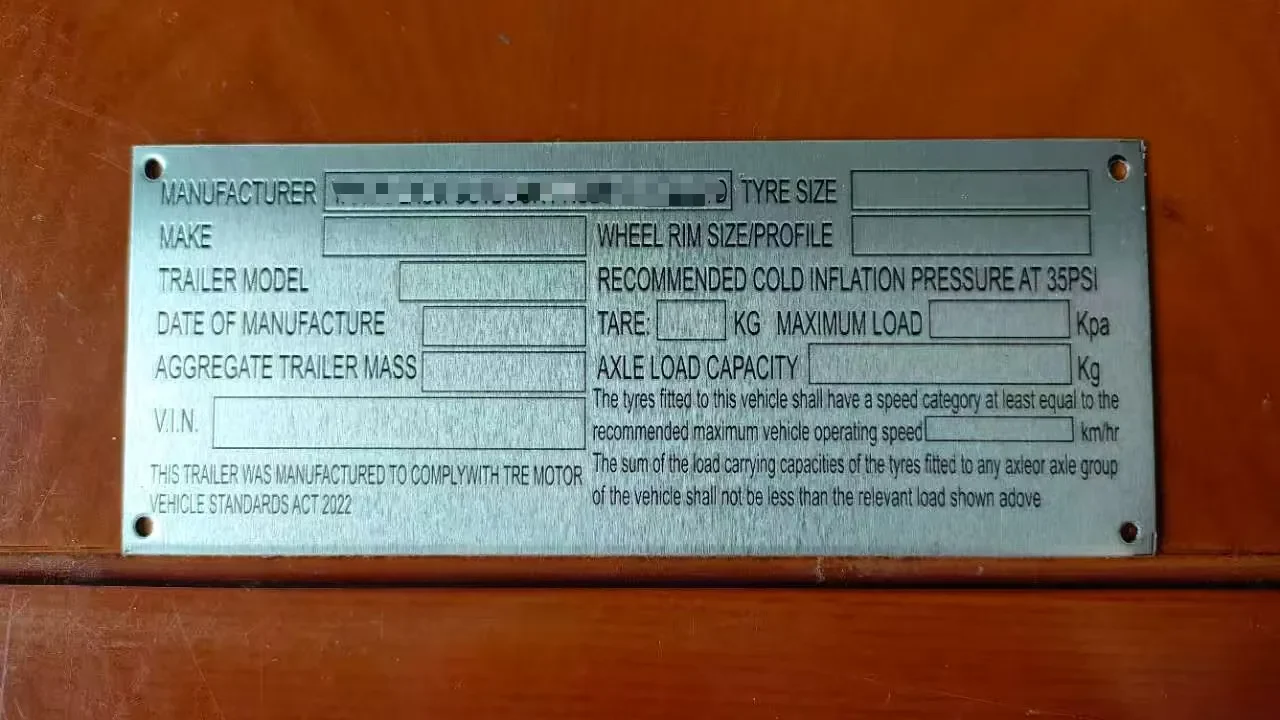
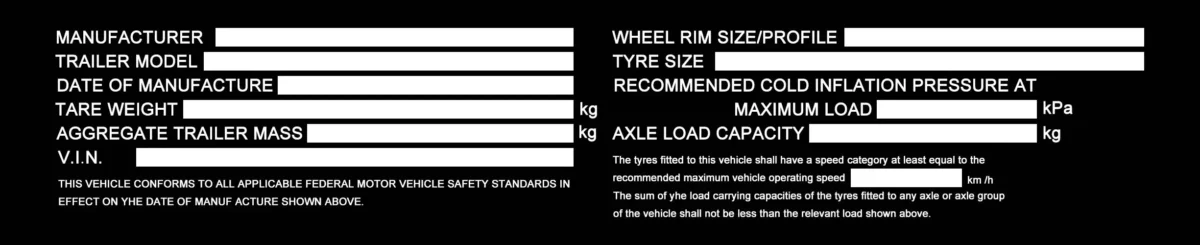
The VIN and the certification label are two separate legal requirements under two separate parts of the US regulations. 49 CFR Part 565 governs the 17-character VIN; 49 CFR Part 567 governs the certification label, where the manufacturer certifies conformity and declares GVWR, GAWR and related data. One is an identity, the other a certification and a set of ratings.
On the trailer they usually sit close together on the frame or drawbar, which is why they get confused. The label carries GVWR, GAWR, tire and rim data and the certification statement; the VIN is a number stamped into the frame or carried on the same permanent plate. A unit can have a perfectly valid VIN and still carry an inconsistent certification label.
Registration authorities check both. List them as two separate line items with two photographs, and confirm the current requirements with the relevant authority rather than relying on a supplier’s template.
The Rating Plate and the Documents That Must Agree
A mismatch between the rating plate and the shipping documents is a real registration problem, not a clerical detail. The registering authority compares the paper record against the physical unit, and one inconsistent field can send the file back after the container has cleared. The fields that must agree are the VIN, GVWR and GAWR, model, axle count, tire and rim data and, where a European approval is involved, the CoC or Declaration of Conformity. The commercial invoice, packing list and physical unit should all describe the same trailer.
| Field | Rating plate / certification label | CoC (where applicable) | Invoice and packing list | Physical unit |
|---|---|---|---|---|
| VIN | All 17 characters | Same 17 characters | Same 17 characters | Stamped or on the permanent plate |
| GVWR / GAWR | Declared values | Matching mass values | Check for conflicts | Consistent with axle and tire fitment |
| Model and trailer type | Model designation | Approved type / variant | Same designation | Same configuration |
| Axle count | Stated | Stated for the approved type | Stated | Count the axles |
| Tire and rim data | Size and rating on the label | Referenced in the approval | Often listed | Read the tire sidewall and rim |
| Manufacturer / WMI | Manufacturer name | Manufacturer name | Same legal entity | Plate matches the WMI |
How a manufacturer arrives at the declared GVWR and GAWR is a separate engineering question, covered in our guide to boat trailer GVWR and frame loads. For VIN and plate purposes, the number on the plate, in the approval documents and at registration must be the same. Plate material belongs in the purchase specification: it has to resist abrasion, ultraviolet exposure and weather, and photosensitive anodized aluminum is a common choice — a selection recommendation, not a regulation. Confirm the accepted construction with the relevant authority.
Other Markets Do Not Follow the US VIN Rule
The 17-character US VIN rule is not a global rule, and no importer should assume it applies everywhere. Europe, Australia and other markets identify and approve trailers through their own frameworks; a US-spec VIN plate alone does not make a trailer registrable there.
In the European Union the route is type approval and the CoC or Declaration of Conformity under Regulation (EU) 2018/858, not Part 565; our guide to boat trailer CE and WVTA type approval covers that layer. Australia handles trailers through the RAV and ROVER systems under the RVSA, a different regime again. Country-by-country practice varies, as set out in boat trailer regulations by country.
Specify the destination market before the VIN and plate are designed, not after the units are built. Do not assume a US VIN plus a commercial invoice satisfies an EU or Australian registration file. Confirm the current requirements with the relevant authority, or your notified body where type approval is involved, before signing off on plate artwork and documents.
Importer Verification Checklist
A short, repeatable checklist catches most VIN and plate problems before the container ships. Run it on the first article of a new model and sample it on every batch.
- Compare the VIN in all three places. Stamped on the frame, on the permanent plate and on the documents; all 17 characters must match.
- Validate the check digit. Confirm position 9 and query any VIN that fails validation.
- Match the descriptor to the unit. Use the manufacturer-filed decoding key against the actual axle configuration and length.
- Confirm GVWR and GAWR on the plate. Check they agree with the CoC and order specification.
- Cross-check the CoC fields. Verify VIN, type, variant and mass values against the plate.
- Reconcile invoice and packing list. Confirm model, quantity and identifying data describe the same units.
- Retain photographs. Keep clear photos of the plate, frame stamping and certification label with the batch record.
- Check destination registration requirements. Confirm the identification, labeling and document set the authority expects, including state-level rules in our guide to boat trailer registration and title by state.
These checks belong in the pre-shipment stage, alongside dimensional and weld inspection, rather than with the receiving clerk; see our pre-shipment inspection guide for boat trailer orders for the wider intake protocol. Record any legal interpretation from the relevant authority, not a supplier’s assurance.
Frequently Asked Questions
Do boat trailers have a 17-digit VIN?
In the US, yes. Under 49 CFR Part 565 a trailer’s VIN is 17 characters with every position filled, a check digit in position 9, and no repeats within a 60-year period starting with model year 1980. That is a US requirement, not a global one; EU and Australian trailers are identified through their own approval systems. Confirm the requirement that applies to your destination market with the relevant authority.
Where is the VIN on a boat trailer?
The VIN must be clear and indelible, marked on a part not designed to be removed or on a permanently affixed plate or label. On a boat trailer it is commonly found on the drawbar or front frame member, often close to the certification label. Check the tongue and the forward crossmember first, and photograph whatever you find. A removable tag is not an acceptable substitute.
What is a WMI code?
A WMI, or World Manufacturer Identifier, is the first three characters of the VIN and identifies the manufacturer. A large-volume maker uses positions 1 to 3; a low-volume maker uses positions 1 to 3 plus 12 to 14. SAE International coordinates assignment in the US, and a manufacturer outside the US applies for a Non-US WMI. The manufacturer must file its VIN decoding information with NHTSA at least 60 days before first use.
Is the VIN the same as the certification label?
No. 49 CFR Part 565 governs the VIN, the 17-character identifier, while 49 CFR Part 567 governs the certification label, which carries the GVWR, GAWR, tire and rim data and the manufacturer’s certification statement. They are two separate requirements and often sit close together on the frame. An importer needs to verify both, not just the number.
Does a trailer VIN have an engine code?
No. A trailer’s vehicle descriptor section, positions 4 to 8, encodes make, trailer type, body type, length and axle configuration, and it has no engine field because a trailer has no engine. Which character carries which attribute is chosen by the manufacturer and filed with NHTSA, so use the manufacturer-filed decoding key rather than a generic chart.
Do all countries use a 17-digit VIN?
No. The 17-character VIN under 49 CFR Part 565 is a US requirement. The EU works through type approval and the CoC or Declaration of Conformity under Regulation (EU) 2018/858, and Australia uses RAV and ROVER under the RVSA. Never assume a US VIN plate alone satisfies another market. Confirm the current requirements with the relevant authority before you place an order.
VIN and rating-plate details are easiest to settle at the specification stage, while the plate artwork and document set are still open. If you are importing boat trailers and want to agree the identification, labeling and paperwork for a target market before production, contact us to discuss your requirements.