
A used boat trailer is worth buying only after a structural and mechanical check. Inspect the frame for rust-through, test the wheel bearings for play, confirm the lights and brakes work, and verify the VIN matches the title. Most used rigs need a bearing re-pack (every 6 months in marine use) plus new tires and a corrosion review before they are safe on the road.
Why a pre-purchase inspection protects your money
A used boat trailer hides most of its wear where you cannot see it, so a 30-minute inspection before you pay prevents the most expensive failures. The seller’s “runs great” is not a substitute for your own eyes on the metal.
The biggest avoidable cost is a bearing or hub failure at highway speed. Bearings fail on boat trailers for a predictable reason: a hot hub dropped into cold launch water creates negative pressure that pulls water past the seal. Catching that before you buy is the difference between a $40 service and a $400 hub.
Start with the paperwork: VIN, title and registration
Paperwork is the cheapest thing to check and the most expensive to fix if it is wrong, so confirm it before you look at the metal. Match the VIN stamped on the frame to the title and any registration document.
Title and registration rules differ by destination. Most U.S. states require a title above a weight threshold, but New Mexico does not require trailer registration at all, and several states exempt light trailers. In the EU a trailer travels on a Certificate of Conformity (CoC) tied to whole-vehicle type approval under Regulation (EU) 2018/858; in Australia it must be recorded in the RAV under the Road Vehicle Standards Act 2018; in New Zealand it needs registration and a WoF. If you are importing the used trailer, confirm the conformity documents match the destination market before you commit.
One distinction matters for U.S. buyers: 49 CFR Part 393 sets brake and equipment rules for commercial motor vehicles, while a private, non-commercial trailer is mainly governed by state law. Check the specific requirement with your state’s motor vehicle agency rather than assuming the federal rule applies to you.
| Market | What the used trailer must show |
|---|---|
| United States | Title by state above a weight threshold; New Mexico needs no registration; private use follows state law, not 49 CFR Part 393 |
| European Union | Certificate of Conformity (CoC) tied to WVTA under Regulation (EU) 2018/858 |
| Australia | RAV entry under the Road Vehicle Standards Act 2018 |
| New Zealand | Registration and a WoF; a light trailer is loaded at or below 3,500 kg |
Frame and structure: where trailers actually fail
The frame carries every load, and rust at the welded joints is the failure point most buyers miss. Run a screwdriver along the inside of the main rails and across every crossmember; if the metal pits or flakes under light pressure, the section has lost strength you cannot restore with paint. Pay special attention to the welds where the axle mounts and where the tongue meets the frame, because those are the highest-stress points.
Frame shape affects how water collects. An I-beam main rail resists vertical bending well and suits heavier builds; a channel (C-section) rail is lighter but, if the open side faces up, it traps water and corrodes from inside. A tube frame seals better but hides internal rust. None of these is automatically bad in a used trailer, but each has a known weak spot to probe.
Where the trailer was used tells you how much life remains. Hot-dip galvanizing to ISO 1461 gives a metallurgical, sacrificial coating, but saltwater accelerates wear, and a used salt-launched trailer will show more bare steel at the welds than a freshwater one. The coating details belong in the galvanizing section below.
| Component | What to look for | Reference point |
|---|---|---|
| Main frame rails | Pitting, flaking, soft spots under a screwdriver | Galvanizing to ISO 1461; bare area >0.5% or 10 cm² needs repair |
| Welds and joints | Cracks, rust bleed, gaps at axle and tongue | Highest-stress points; cracks are structural, not cosmetic |
| Crossmembers | Internal rust on channel sections, rot at bunks | Water traps under bunks and carpet |
| Tongue and coupler | Rust at the ball socket, cracked mounting | Tongue weight is 5–10% of GTW; weakness here is dangerous |
Galvanizing and corrosion: reading the metal
The finish tells you how the trailer was used, and salt exposure shortens a galvanized coating’s life. A sound hot-dip galvanized finish (ISO 1461) shows a uniform matte grey with some “spangle”; shiny bare steel at edges, welds and bolt holes means the coating has been lost there.
Watch for mixed metals. An aluminum hull on a steel trailer, or steel fittings bolted to aluminum, sets up galvanic corrosion where the less noble metal eats away; the corrosion pattern is a record of how the trailer was maintained and what it was asked to carry.
Axles, suspension and wheel bearings
Wheel bearings are the most common roadside failure on used boat trailers, and the damage shows up long before the wheel falls off. Jack up each wheel, grip the tire at the top and bottom, and rock it; any movement at the spindle means worn bearings or loose preload. Pull the grease cap and look at the grease: a milky or watery color means water has entered, and discolored (blue-brown) bearing races mean the hub has been run hot.
Service intervals are short in marine use for a reason. Bearings should be re-packed every 6 months, or every 9 months if you launch more than 30 times a year; on a general-use trailer the interval stretches to 12 months or 12,000 miles. The correct preload window is about 0.002 inch—typically snugged to 50–75 ft-lb and then backed off to the final setting. A properly maintained hub can exceed 100,000 miles, so a neglected one on a used trailer is a known cost, not a gamble. Read our guide to boat trailer bearings in saltwater for the failure mechanism in detail.
Check the axle itself for bent spindles, cracked spring hangers and seized torsion arms; either is a replacement, not a repair.
Wheels and tires
Tires age out faster than they wear out on trailers that sit unused, so read the date code before you trust the tread. Trailer tires carry a DOT date code on the sidewall; most tire makers and road-safety bodies advise replacing tires more than about 5–6 years old regardless of remaining tread—confirm the exact guidance with the tire manufacturer, because the number varies by brand and climate.
Also check the wheel itself. Aluminum wheels corrode at the lug seat and steel wheels rust at the rim; either can loosen a lug or leak air.
Lights, wiring and connectors
A lighting fault is the fastest way to fail a safety check and the easiest to overlook in daylight, so test every lamp with the trailer plugged into a tow vehicle. Walk around and confirm tail, stop, turn and—on wider rigs—clearance lamps all work. Trailers wider than 80 inches require separate rear clearance lights that must not be combined with the tail lights, per 49 CFR 393.
The connector type tells you what the trailer supports. A 4-pin flat handles the basics, a 5-pin adds a reverse circuit for surge-brake lockout, and a 7-pin (built to SAE J560) adds a 12V charge line, electric brakes, reverse and an auxiliary circuit. For a boat trailer, prefer sealed, submersion-rated connectors and use dielectric grease on the contacts, because the harness gets dunked every launch. Our full boat trailer lights and wiring guide covers testing step by step.
Brakes, breakaway and the legal line
Whether your used trailer needs brakes depends on its weight and your state, and the breakaway system must hold for at least 15 minutes if fitted. Under 49 CFR 393.42, a trailer with GVWR at or below 3,000 lb (1,361 kg) is exempt from federal brake rules only if the towed axle weight also stays within 40% of the towing vehicle’s axle-weight sum; above that, brakes are required. Surge brakes are capped by 49 CFR 393.48(d): at GVWR up to 12,000 lb the trailer must not exceed 1.75 times the tow vehicle’s GVWR, and between 12,000 and 20,001 lb not more than 1.25 times.
For breakaway, 49 CFR 393.43(d) requires any braked trailer to auto-apply if it separates and to hold for at least 15 minutes. On a used trailer, test the breakaway battery, cable and switch, and confirm the surge actuator is not seized. Again, these are federal rules for commercial vehicles; a private trailer follows state law, so confirm the threshold that applies to you with your state agency. See whether a boat trailer needs brakes for the state-by-state picture.
Winch, straps and tie-downs
The winch and tie-downs hold your boat on the trailer, and worn straps are a silent risk that turns into a lost boat at the ramp. Inspect the winch strap for fraying, rot or rusted stitching, and prefer strap over cable because a failed strap is far less dangerous than a snapped steel cable; confirm the winch capacity is about twice the boat’s weight.
Check the winch mechanism for slipped gears, a frozen ratchet and a corroded base mount, and replace a questionable winch; it is cheap insurance next to the boat it secures.
Match the trailer to your boat before you pay
A trailer that fits your neighbor’s boat may overload yours or leave it unsupported, so confirm the ratings against your specific hull. If you are unsure of the numbers, our boat trailer sizes and weight capacity reference and our guide to choosing the right boat trailer walk through the match.
Tongue weight is the number most buyers skip. For a boat trailer it should sit at 5–10% of gross trailer weight (GTW), with most manufacturers recommending 7–10%; too little invites sway, too much overloads the tow vehicle’s rear axle. Remember that tongue weight counts against the tow vehicle’s payload, not its towing capacity, so weigh the loaded tongue if you cannot confirm it another way.
The used boat trailer inspection checklist
Use one ordered checklist so you do not miss the items that cost the most later; write down what you find so you can show the seller.
- Match the VIN on the frame to the title and registration; confirm the destination’s paperwork rules.
- Probe the frame, welds and crossmembers with a screwdriver for soft or pitted metal; note any bare steel beyond ISO 1461 limits.
- Jack each wheel, check for bearing play and pull caps to inspect grease for water and heat damage.
- Read tire date codes and sidewalls; plan replacement if age or cracking exceeds the maker’s guidance.
- Plug in the lights and verify every lamp, including clearance lights on trailers over 80 inches wide.
- Test brakes and the breakaway system; confirm it can hold at least 15 minutes if fitted.
- Inspect the winch strap, bow stop, transom and gunwale straps, and confirm capacity near 2× boat weight.
When the list is clean, the trailer is a candidate; when it is not, use it to deduct from the price or to walk away.
Frequently Asked Questions
How do I check wheel bearings on a used boat trailer?
Jack up each wheel and grip the tire at the top and bottom, then rock it; any movement at the spindle means worn bearings or loose preload. Pull the grease cap and look for milky or watery grease, which signals a failed seal. Plan a re-pack: in marine service bearings should be serviced every 6 months, or every 9 months if you launch more than 30 times a year.
What rust is acceptable on a used boat trailer?
Light surface staining on a galvanized frame is common and not a deal-breaker, but bare steel showing through is a problem. Under ISO 1461, any uncoated area beyond 0.5% of the surface or larger than 10 cm² should be repaired or re-galvanized. A freshwater trailer will show far less corrosion than one launched in salt.
Does a used boat trailer need a title when I buy it?
It depends on where you register it. Most U.S. states require a title above a weight threshold, though New Mexico does not require trailer registration at all. In the EU the trailer travels on a Certificate of Conformity tied to WVTA under Regulation (EU) 2018/858; in Australia it must be entered in the RAV under the Road Vehicle Standards Act 2018; in New Zealand it needs registration and a WoF.
How much tongue weight should a boat trailer have?
For a boat trailer, tongue weight should sit at 5–10% of gross trailer weight (GTW), and most manufacturers recommend 7–10%. Too little and the rig sways; too much and you overload the tow vehicle’s rear axle.
How do I test the lights and brakes on a used trailer?
Plug the trailer into the tow vehicle and walk around checking tail, stop, turn and clearance lamps—trailers wider than 80 inches need separate rear clearance lights per 49 CFR 393. For brakes, check the breakaway cable and battery and confirm the system can hold for at least 15 minutes after separation, as required by 49 CFR 393.43(d). Use dielectric grease and prefer sealed, submersion-rated connectors.
Is a galvanized or aluminum used trailer better?
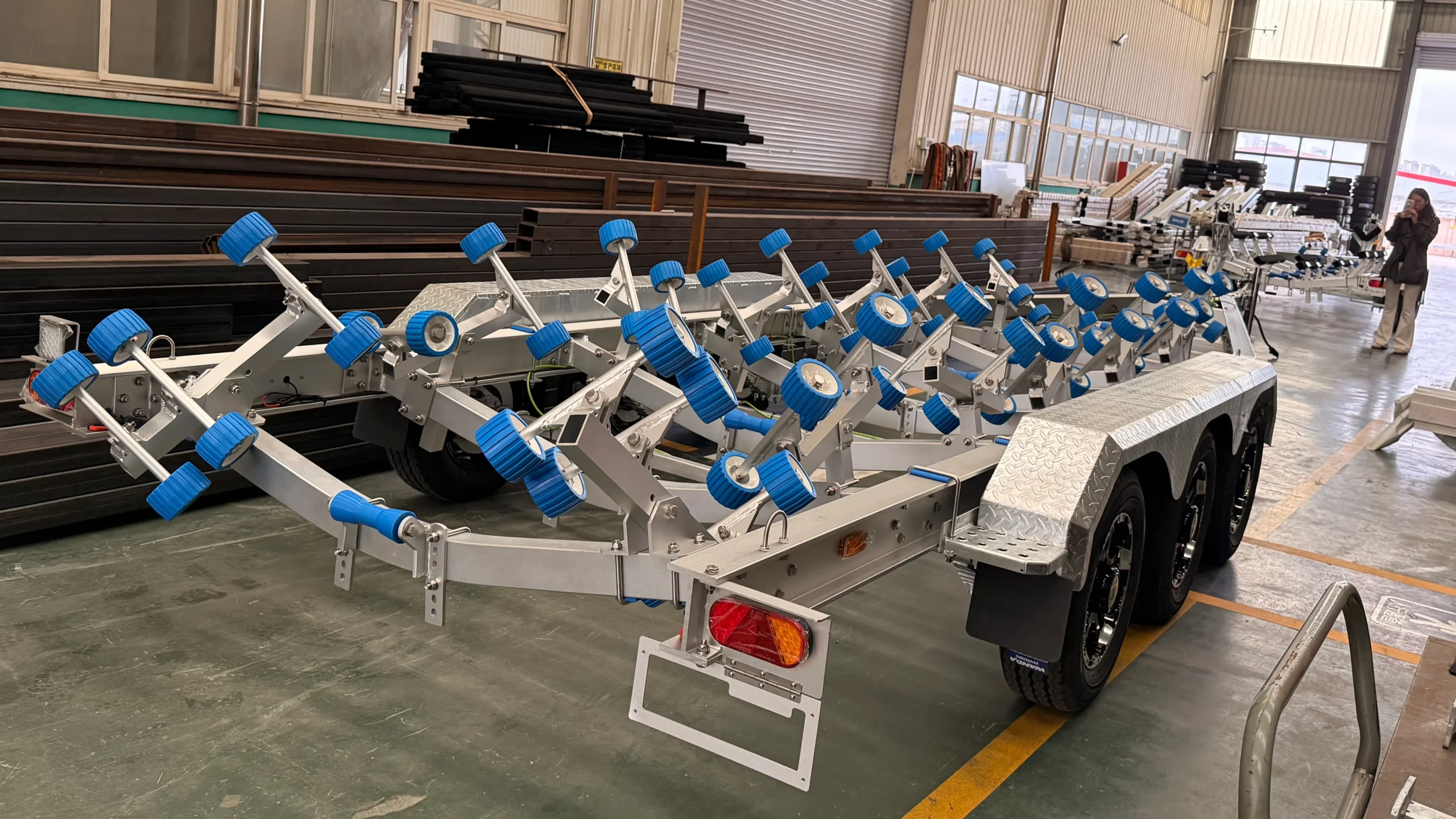
It depends on where you launch. A galvanized steel trailer built to ISO 1461 resists rust well in freshwater and costs less to buy; an aluminum trailer avoids galvanic corrosion entirely in salt and weighs less, but costs more. Watch for mixed metals either way—an aluminum boat on a steel trailer, or steel fittings on aluminum, can trigger galvanic corrosion. Our hot-dip galvanized twin-axle marine trailer shows the construction standard we build to.
Buying used is only the first step—getting the right trailer for your boat and your water is what pays off for years. If you would rather start with a trailer built to a known standard, contact us for a quote on a new galvanized or aluminum build, or read about choosing the right boat trailer before you decide.