
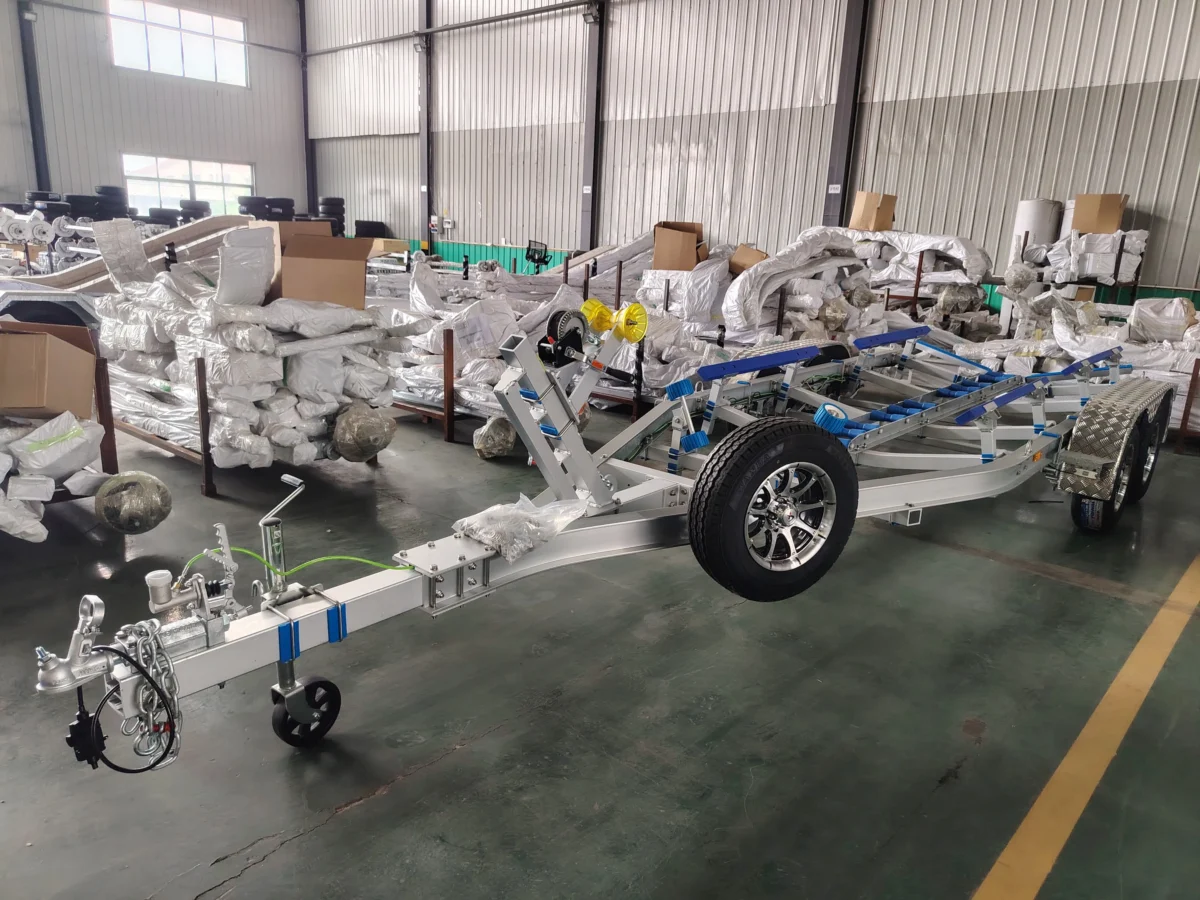
Importing boat trailers is manageable once you separate classification, duties and conformity. Trailers fall under HS Chapter 87, heading 8716, but the exact subheading and duty rate depend on design and destination — confirm both with a licensed customs broker. You also need conformity documents: US DOT entry, EU WVTA, Australian VTA and New Zealand registration. Plan shipping by 40HQ because trailers cube out before they weigh out.
HS Classification: Where Boat Trailers Sit in the Tariff
Boat trailers are classified under HS Chapter 87, heading 8716, which covers trailers and semi-trailers for the transport of goods or persons, including those not mechanically propelled. This is the starting point for every import: the heading tells customs what kind of product you are declaring, but it does not by itself tell you the duty you will pay.
The precise subheading within 8716 — and the rate that attaches to it — depends on the trailer’s design, axle count, maximum mass and intended load. A single-axle unbraked dolly, a tandem-axle marine trailer and a multi-axle commercial unit can land in different subheadings, and those subheadings carry different treatment across markets. For that reason we do not publish a single duty percentage: the figure is not constant and stating one would be misleading.
Treat HS classification as a broker task, not a guess. A licensed customs broker will confirm the correct subheading for your specific model and a binding ruling where one is available. If you are sourcing a range of models — for example a hot-dip galvanized twin-axle marine trailer alongside lighter single-axle units — have each variant classified individually, because mass and braking configuration change the subheading.
Duties and Trade Agreements: Why Rates Vary So Widely
Duties on imported boat trailers vary widely by subheading and by the trade agreement in force between the exporting and importing country. There is no single global rate, and a rate that applies to one model in one market may not apply to the same model elsewhere.
Some markets admit trailers at a preferential or duty-free rate under a free trade agreement, while others apply the standard most-favoured-nation rate for the relevant subheading. The difference can be material to your landed cost, which is why the duty line must be confirmed before you quote a customer or commit to a container.
Two practical points for importers:
- Confirm the applicable rate and any preferential treatment with a licensed customs broker before shipment — do not rely on a published figure that may be out of date or tied to a different subheading.
- Keep your certificate of origin and commercial documentation in order, because preferential rates normally require evidence that the product qualifies under the relevant agreement.
Where your sourcing crosses multiple destinations, build a per-market duty table and refresh it with your broker at least annually. Our overview of boat trailer regulations by country covers the conformity side; duties are the separate financial layer you layer on top.
Conformity Documents by Market
Conformity is the engineering-legal proof that a trailer is legal to register and use in a given market, and the documents differ by destination. Clearing customs is not the same as being road-legal; you usually need both.
For the United States, trailers are handled under the federal motor carrier safety framework and DOT-related requirements; the entry itself is filed through US customs, and for ocean shipments an Importer Security Filing (ISF) is required before arrival. State-level registration then follows separately, and the balance between federal and state rules matters (see the US notes below).
For the European Union, the trailer must carry WVTA — whole-vehicle type approval under Regulation (EU) 2018/858 — supported by a Declaration of Conformity. Without a valid DoC and type approval, EU registration is not possible. The detailed requirements are covered in our CE & WVTA type approval guide.
For Australia, conforming trailers are entered under the Road Vehicle Standards Act 2018 (RVSA) and recorded in the Register of Approved Vehicles (RAV) via the ROVER portal, typically through a Vehicle Type Approval for commercial quantities. For New Zealand, imported trailers must be registered and pass a Warrant of Fitness (WoF) before they can be used on the road.
Each of these is a separate document stream from the customs entry. Importers who treat conformity as an afterthought usually discover the gap at the port, where a unit that has cleared customs still cannot be registered.
Importer of Record and Entry Filing
The Importer of Record (IOR) is the entity legally responsible for the accuracy of the import declaration and for paying duties and taxes. As an importer or distributor you will normally be the IOR for your own shipments, which means the paperwork must be in your name and you carry the compliance risk.
The core entry documents are consistent across most markets:
- A commercial invoice showing the seller, buyer, description, quantity, value and currency of the trailers.
- A bill of lading (or air waybill) evidencing the contract of carriage and the shipped goods.
- A packing list detailing how the units are packed, especially relevant when trailers are knocked down or nested in a container.
- For the United States, an Importer Security Filing (ISF) submitted to US Customs and Border Protection before the vessel departs for the US.
- Conformity evidence for the destination market (WVTA/DoC, VTA/RAV, WoF eligibility or DOT-related entry documentation).
Accuracy on the invoice and the HS subheading matters more than volume. Under-declaring value or misstating configuration invites holds, penalties and a re-classification that lands after the fact. Where a model spans braked and unbraked variants, declare the exact configuration you are importing.
Shipping the Units: Container Reality
Most overseas trailer imports move by sea in containers, and the economics are governed by volume rather than weight. A standard 40HQ (high-cube) container has internal dimensions of 12.032 × 2.352 × 2.698 m, a door opening of 2.340 × 2.585 m, and a volume of about 76.4 m³. Its tare weight is about 3,900 kg and its typical maximum payload around 26.5 t.
Boat trailers are cube-out freight: they fill the container’s volume long before they approach its weight limit. In practice you run out of space at roughly 30–40 percent of the available payload, which is why packing density — not weight — drives your per-unit ocean cost. Nesting frames, partially knocked-down assembly and consistent wheel positions all improve the count per container.
Plan the shipment and the declaration together. The packing list should reflect exactly how many units and what configuration sit in each 40HQ, because that is what your broker files against and what destination inspectors check. For a fuller packing and freight walkthrough, see our guide to shipping boat trailers overseas.
| 40HQ specification | Value | Why it matters for importers |
|---|---|---|
| Internal dimensions | 12.032 × 2.352 × 2.698 m | Sets the usable envelope for nesting and knockdown packing |
| Door opening | 2.340 × 2.585 m | Limits the widest assembled component you can load intact |
| Internal volume | ≈ 76.4 m³ | Cube-out threshold — trailers fill this before reaching weight limit |
| Tare weight | ≈ 3,900 kg | Consumed from the payload allowance before any cargo |
| Typical max payload | ≈ 26.5 t | Rarely the binding constraint for trailer freight |
Common Pitfalls Importers Hit
Most import problems are predictable, and three come up repeatedly for marine trailer buyers.
Anti-dumping exposure. Trailers and trailer components can be subject to anti-dumping or countervailing measures in some markets. Whether a given product and origin is affected changes over time and by specification, so confirm current exposure with a licensed customs broker before you commit to a sourcing country or a volume contract.
Labeling and handedness. Lighting, reflectors and coupling orientation follow market conventions — left-hand-drive markets and right-hand-drive markets expect mirrored layouts. A trailer built for one market’s lighting and towing conventions can require rework to clear another. Specify the destination market’s handedness at the order stage rather than at the port.
Left/right market specifications. Beyond lighting, items such as brake actuation, plug standards and even tyre markings may differ by destination. Importers who assume one build serves every market usually absorb retrofit cost and delay. Align the build specification to the conformity framework of the market you are importing into (US DOT, EU WVTA, Australian VTA or NZ requirements), and document that alignment on the commercial invoice.
Conformity Requirements by Market: At a Glance
The table below summarises the key document or approval for each major destination. It is a planning aid, not legal advice — confirm the current requirement with the relevant authority or a licensed broker.
| Market | Key document / approval | Importer note |
|---|---|---|
| United States | DOT-related entry + ISF (ocean); state registration | Federal motor-carrier rules govern commercial use; private use is largely state-law. Confirm both layers. |
| European Union | WVTA under Regulation (EU) 2018/858 + Declaration of Conformity | DoC must accompany the unit; no type approval means no EU registration. |
| Australia | Vehicle Type Approval; recorded in RAV via ROVER (RVSA) | RVSA framework from 2021; commercial volumes use type approval, not concessional entry. |
| New Zealand | Registration (rego) + Warrant of Fitness (WoF) | Light trailer = laden ≤ 3,500 kg; WoF checks coupling, chains, tyres, lights, mudguards. |
Frequently Asked Questions
Do I need a customs broker to import a boat trailer?
In most markets a licensed customs broker is strongly recommended, and in some the entry must be filed by a registered party. A broker confirms the correct HS subheading, the applicable duty rate, any trade-agreement preference and the entry timing (including the US ISF). Using one reduces the risk of holds, reclassification and penalties.
What documents do I need to import a trailer to the US?
At minimum you need a commercial invoice, a bill of lading, a packing list and, for ocean shipments, an Importer Security Filing (ISF) lodged before arrival. The Importer of Record is responsible for the declaration and duties. Separate from customs, state-level registration and titling then apply, and the federal motor-carrier framework governs commercial use while private use is largely handled under state law.
How do I find the HS code and duty rate for a boat trailer?
Trailers sit under HS Chapter 87, heading 8716, but the subheading and rate depend on the trailer’s mass, axle count and braking configuration. Have a licensed customs broker classify each specific model you import; do not assume one rate covers an entire product range. Where available, request a binding ruling for certainty.
Are boat trailers subject to anti-dumping duties?
Anti-dumping or countervailing measures can apply to trailers or trailer components in certain markets, and the affected products and origins change over time. Confirm current exposure with a licensed customs broker before committing to a sourcing country or a volume order, and keep the assessment on file for your compliance record.
Does a marine trailer need WVTA or VTA conformity before import?
For the EU, yes — a trailer needs WVTA under Regulation (EU) 2018/858 and a Declaration of Conformity to be registered. For Australia, a Vehicle Type Approval and RAV entry under the RVSA are required for commercial volumes. New Zealand requires registration and a WoF. The US uses a different DOT/state framework. Confirm the exact current requirement for your destination with the relevant authority.
How many trailers fit in a 40HQ container?
A 40HQ provides about 76.4 m³ of internal volume (12.032 × 2.352 × 2.698 m) and about 2.340 × 2.585 m of door opening. Because trailers are cube-out freight, the count is limited by volume, not the roughly 26.5 t payload. The exact number depends on whether units are nested, partially knocked down or fully assembled — specify your packing method to get a reliable per-container estimate.
Importing boat trailers is a paperwork discipline as much as a freight one. If you are planning a first or next shipment and want build specifications aligned to your destination’s conformity framework, contact us for a quote and we can discuss models, packing and documentation.