The best boat trailer finish depends on where you launch. Hot-dip galvanized steel (ISO 1461, 35–85 µm coating) is the most corrosion-resistant choice for submerged frames and saltwater. Powder coat looks clean but chips at edges and corrodes from a scratch. Liquid paint is cheapest and shortest-lived. Aluminum frames are often left bare or anodized.
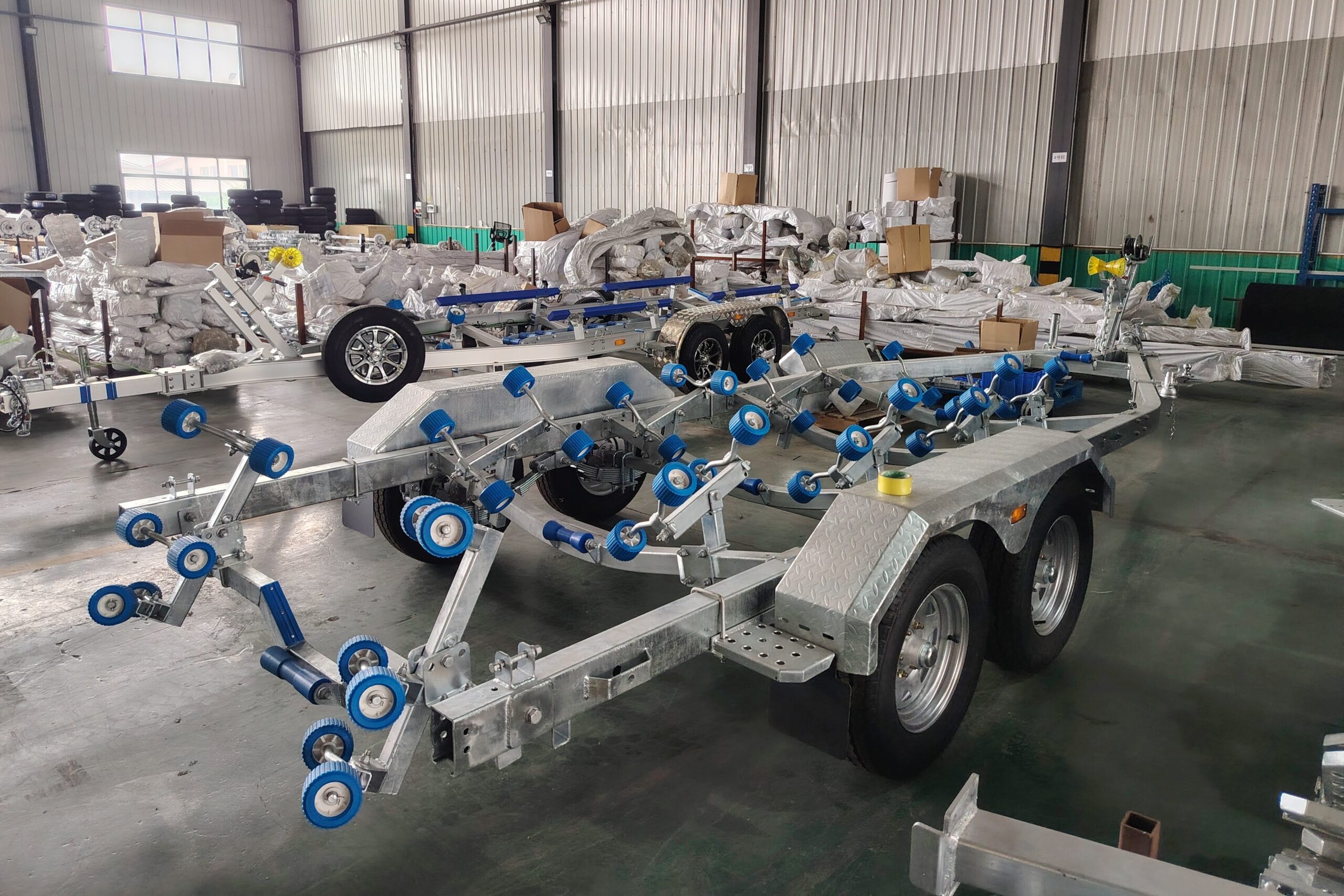
Hot-Dip Galvanized: The Submerged-Steel Standard
Hot-dip galvanizing is the most durable factory finish for steel boat-trailer frames that spend time in the water. It is governed by ISO 1461, which sets the minimum coating thickness by base-steel thickness rather than by a single number. Unlike a paint film that merely sits on the surface, the zinc layer forms a true metallurgical bond with the steel, so it cannot peel or flake as a coating.
The process is a sequence of cleaning and dipping steps. After fabrication the steel is degreased, pickled in acid to remove scale, fluxed, and then immersed in molten zinc at roughly 450 °C. The zinc reacts with the iron to form a series of zinc-iron alloy layers topped by a layer of nearly pure zinc, then the part is cooled. Because the bond is metallurgical, the finishing behaves as part of the steel rather than a separate skin.
Galvanizing protects steel two ways at once. It acts as a barrier, and it provides sacrificial (cathodic) protection: if the surface is scratched down to bare steel, the surrounding zinc continues to corrode first and shields the exposed area. The typical atmospheric corrosion rate of zinc is 0.5–4 µm per year across the ISO 9223 C1–C5 environments, so a thicker coating simply lasts longer before the steel is reached.
The coating thickness you actually get scales with the thickness of the steel being dipped. The table below shows the ISO 1461 minimums, which is why heavy main beams and crossmembers can carry a noticeably thicker layer than thin brackets.
| Steel thickness | Local minimum (µm) | Average minimum (µm) | Approx. mass/area (g/m²) |
|---|---|---|---|
| < 1.5 mm | 35 | 45 | ≈ 321 (45 × 7.14) |
| ≥ 1.5–3 mm | 45 | 55 | ≈ 393 |
| > 3–6 mm | 55 | 70 | ≈ 500 |
| > 6 mm | 70 | 85 | ≈ 607 |
The conversion uses the ISO relationship of roughly 1 µm ≈ 7.14 g/m² of zinc. ISO 1461 also sets acceptance limits: any uncoated area must not exceed 0.5% of the surface or 10 cm² total, and where it does the part must be repaired or re-dipped. For a deeper look at how this finish is applied to our own frames, see the hot-dip galvanized boat trailer overview.
Powder Coating: A Clean Look With a Weak Point
Powder coating is an electrostatic-applied, heat-cured finish that gives a uniform, colored surface without the drips and solvent smell of liquid paint. The dry powder is sprayed onto a grounded part, clings by static charge, and is then cured in an oven where it flows into a continuous film. Typical dry-film thickness lands around 1–3 mil (about 25–75 µm).
Its weakness is edges and impact. Because the powder layer is thin and brittle relative to steel movement, it tends to chip at cut edges, bolt holes, and the spots where the hull or winch strap rubs. Once a scratch reaches bare steel, corrosion does not stay put: moisture travels under the film and the coating can lift away from the metal, so a small nick can spread into a larger rust bloom. Powder coat is a good aesthetic finish for parts that stay dry, but on a repeatedly submerged frame it hands corrosion a clear starting line.
Liquid Paint and E-Coat: Cheapest and Best Crevice Coverage
Liquid paint is the lowest-cost finish and the shortest-lived of the group. A brush- or spray-applied paint system can look acceptable on day one, but every pinhole and thin spot is a future rust site, and the film offers no sacrificial protection — once it is breached the steel underneath is on its own. For that reason liquid paint is common on budget trailers and on touch-ups rather than as a primary marine defense.
E-coat (electrophoretic deposition) sits between paint and galvanizing in capability. The part is immersed and the coating is deposited electrically, which gives it unusually good coverage inside seams, box sections, and crevices that a spray gun cannot reach. E-coat is often used as a primer under a topcoat rather than as the final surface. Where a painted system is specified, the relevant reference for coating durability in corrosive environments is ISO 12944, which classifies environments and recommends coating systems accordingly.
Anodizing: The Finish for Aluminum Frames
Anodizing is an electrochemical process that grows a controlled oxide layer on the surface of aluminum, turning the metal’s own skin into a harder, more corrosion-resistant, and optionally colored surface. It is the standard decorative-and-protective treatment for aluminum trailer frames and components, not for steel. Anodizing does not add a separate film that can peel; it converts the top layer of the aluminum itself.
The trade-off is repairability. A scratched anodized surface cannot be field-restored to match the original layer the way a zinc-rich primer restores galvanizing — at best you clean and isolate the area to stop further oxidation. For a full comparison of how aluminum and galvanized steel frames differ in practice, the aluminum vs galvanized boat trailer guide covers the trade-offs beyond just the surface finish.
How Each Finish Handles Saltwater
Saltwater is the harshest test a trailer finish faces, and the rankings are consistent. Hot-dip galvanized steel performs best for frames that are regularly submerged, because the sacrificial zinc keeps protecting even through scratches and because the coating thickness can be substantial. Aluminum with an anodized or bare surface also fares well in salt, since aluminum forms its own protective oxide and does not rust — which is why a dual-axle all-aluminum trailer is a common saltwater choice.
Powder coat is the middle case: it resists salt while intact, but a single edge chip or rub point lets salt creep beneath the film and undermine it. Liquid paint is the shortest-lived in salt and needs the most frequent renewal. Where two dissimilar metals meet in a salt environment, finish choice also affects galvanic corrosion, because coating breaches can set up the conditions for one metal to eat the other.
Repair and Touch-Up
Repair differs sharply by finish, and doing it wrong can make corrosion worse rather than better. The practical rules:
- Galvanized steel: clean the area, remove loose zinc or rust, and apply a zinc-rich primer or cold-galvanizing compound so the repair remains sacrificial. Do not seal bare steel with ordinary paint alone.
- Powder coat: spot-repair by sanding the lifted edge, treating any rust, and applying a compatible touch-up or a small re-coat. Because the original was oven-cured, a field repair will not match exactly but will stop spread.
- Liquid paint: the easiest to refresh — sand, prime if needed, and repaint the affected area; the challenge is consistency, not chemistry.
- Anodized aluminum: clean and isolate scratches; full restoration of the anodized layer is a shop process, not a field one.
Routine washing after saltwater use and annual inspection stretch every one of these finishes. Our boat trailer maintenance guide lays out the wash-down and inspection steps that protect whichever coating you choose.
Cost and Service-Life Comparison
The table below sets out how the common finishes typically compare. The life figures are industry-typical patterns, not guarantees — actual results depend on coating thickness, launch frequency, and maintenance, and the galvanizing column can be estimated from the ISO 1461 thickness table above against the 0.5–4 µm/year corrosion rate. Confirm expectations with the relevant standard and your supplier.
| Finish | Typical life — freshwater | Typical life — saltwater | Repairability | Relative cost |
|---|---|---|---|---|
| Hot-dip galvanized (steel) | 20–40+ yrs (atmospheric) | 15–30 yrs submerged (varies) | Field-repairable with zinc-rich primer | Medium |
| Powder coat | 8–15 yrs | 5–10 yrs (chips at edges) | Spot repair possible | Medium–High |
| Liquid paint | 3–7 yrs | 2–5 yrs | Easy touch-up | Low |
| E-coat (as primer) | 10–20 yrs | 8–15 yrs under topcoat | Partial; usually full re-dip | Medium |
| Anodized (aluminum) | 15–25 yrs | 10–20 yrs | Hard to field-repair | Medium–High |
Cost tiers are relative, not quotes; pricing varies by region, specification, and freight, so confirm the actual figure with the manufacturer. Galvanizing looks more expensive up front than paint but rarely needs renewing, while paint is cheap to apply and cheap to re-apply because it needs to be.
Which Finish Should You Choose?
Choose by environment first, then by budget. For a steel trailer launched in saltwater or brackish water, hot-dip galvanizing to ISO 1461 is the defensible default because the coating is thick, sacrificial, and field-repairable. For a steel trailer used only in fresh water with rare dunking, powder coat can be acceptable if you accept edge-chip maintenance, and liquid paint is viable only where replacement or frequent repainting is planned. For aluminum frames, bare or anodized aluminum is the natural fit and avoids the rust question entirely.
Budget plays a role but should not override exposure: spending a little more on galvanizing up front typically costs less over the life of the trailer than repeatedly repairing a failed paint or powder system in a salt environment. If you are matching a finish to a specific rig, weigh the launch environment, how often the frame is submerged, and how comfortable you are doing field repairs.
Frequently Asked Questions
What is the best finish for a saltwater boat trailer?
For a steel frame, hot-dip galvanizing to ISO 1461 is the most corrosion-resistant common finish because the zinc layer is thick and sacrificial. For an aluminum frame, bare or anodized aluminum is the better match because aluminum does not rust and forms its own protective oxide in salt.
Does powder coat prevent rust on a boat trailer?
Only while it stays intact. Powder coat resists corrosion as a barrier, but it is thin (about 1–3 mil) and chips at edges and rub points; once a scratch reaches steel, moisture travels under the film and rust can spread. It is less robust than galvanizing for regularly submerged frames.
Can you powder coat over galvanized steel?
It is possible with the correct pre-treatment, but it is not common for marine trailers because the two finishes solve different problems. Galvanizing already provides sacrificial protection, while powder coat mainly adds color and a sealed look. If the goal is corrosion defense in water, galvanizing alone is usually sufficient.
How thick is hot-dip galvanizing on a boat trailer?
The minimum thickness follows ISO 1461 and depends on steel thickness: 45 µm average for steel under 1.5 mm, 55 µm for 1.5–3 mm, 70 µm for 3–6 mm, and 85 µm average for steel over 6 mm. Heavier structural members therefore carry the thickest layers.
Is anodizing better than paint for aluminum trailer frames?
For aluminum, anodizing converts the metal’s own surface into a harder, corrosion-resistant layer and will not peel, whereas paint is a separate film that can chip and expose the alloy. Anodizing is harder to field-repair, but for long-term salt exposure it is generally the more durable choice than liquid paint.
How do you repair a scratched galvanized boat trailer?
Clean the area, remove any loose material or rust, and apply a zinc-rich primer or cold-galvanizing compound so the repair remains sacrificial like the original coating. Avoid sealing bare steel with ordinary paint alone, because that stops the galvanic protection the surrounding zinc would otherwise provide.
If you are specifying a trailer for saltwater use, our hot-dip galvanized twin-axle marine trailer is built around an ISO 1461 galvanized frame. Contact us for a quote with your boat size and launch environment and we will match the finish to the conditions.