
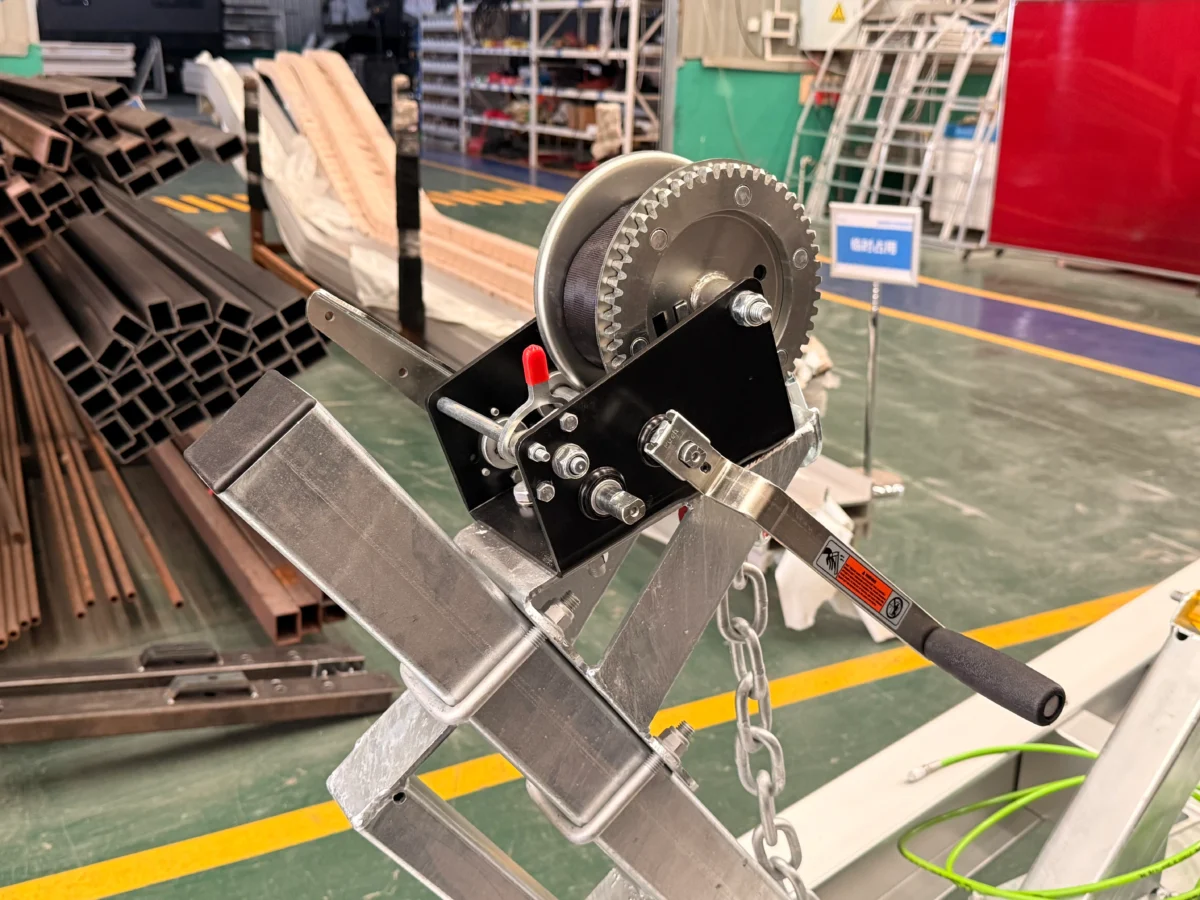
A boat trailer winch, winch strap and tie-down straps work together to load and hold your boat. Choose a winch rated at roughly 2× your loaded boat weight, use a strap rather than cable on the winch, and secure the hull with transom and gunwale tie-downs plus safety chains. Inspect straps for fraying and replace them before they fail.
Winch Types: Manual Ratchet, Brake/Self-Locking, and Electric
The winch is the component that pulls the boat up the trailer bunks and holds it against the bow stop. Three designs cover nearly every recreational and light-commercial rig, and the right one depends on boat weight, how often you launch solo, and whether you have shore power available.
A manual ratchet winch uses a hand crank and a pawl that locks the drum between pulls. It is simple, cheap, and easy to repair, which is why it remains common on small to mid-size trailers. The downside is physical effort: you are doing the pulling, so it suits boats you can comfortably crank.
A brake or self-locking winch adds a mechanical brake inside the drum so the load cannot back-drive the crank, even on a steep ramp. This matters when the trailer sits nose-down at a launch and the boat’s weight would otherwise try to unwind the winch. Many manual winches include this feature; it is worth confirming before you buy.
An electric winch replaces the crank with a 12V motor powered from the tow vehicle battery through the trailer connector or a dedicated lead. It is the practical choice for heavier hulls or for anyone who launches alone. Electric winches draw meaningful current, so the wiring and the tow vehicle’s electrical system must be up to the load, and the motor must be sealed against spray.
For any winch, the mounting bolts, the winch post, and the bow stop must all be in sound condition, because the winch is only as strong as the structure it sits on. When evaluating a trailer, the guide to choosing the right boat trailer covers how winch and frame choices fit the whole package.
Sizing the Winch to Your Boat
Winch capacity should be sized well above the boat it pulls, because the winch fights gravity, ramp angle, and a wet, heavy hull, not just static weight. The common industry rule of thumb is to select a winch rated at roughly 2× the loaded boat weight — boat, fuel, water, gear, and motor together, not the dry shipping weight.
This 2× figure is a rule of thumb, not a published engineering specification, and it leaves margin for a steep or slippery ramp where the effective pull is higher than on flat ground.
To find your number, weigh the rig or read the boat’s “loaded” figure, then double it and pick the nearest standard winch rating above that result. Matching the winch to the trailer’s rated capacity also helps; our boat trailer sizes and weight capacity reference shows how axle, frame, and rating relate.
| Loaded boat weight (approx.) | Recommended winch capacity (2× rule) | Typical application |
|---|---|---|
| Up to 1,500 lb (680 kg) | ~3,000 lb (1,361 kg) | Small aluminum jon boat, skiff, lighter Personal Watercraft combos |
| 1,500–3,000 lb (680–1,361 kg) | ~3,000–6,000 lb (1,361–2,722 kg) | Fiberglass runabout, aluminum fishing boat |
| 3,000–5,000 lb (1,361–2,268 kg) | ~6,000–10,000 lb (2,722–4,536 kg) | Cuddy cabin, wake boat, small cruiser |
| 5,000–8,000 lb (2,268–3,629 kg) | ~10,000–16,000 lb (4,536–7,257 kg) | Larger cabin cruisers on tandem-axle trailers |
Treat the table as a planning aid. The exact winch you need depends on ramp angle, hull shape, and how the boat sits on the bunks, so confirm the final choice against the trailer manufacturer’s rating and your own loaded weight.
Winch Strap vs Cable
Most modern boat trailer winches ship with a strap rather than a steel cable, and for good reason. A woven strap lies flat on the drum, stores easily, and — critically — will not whip or snap back like a tensioned steel cable if it fails. A broken cable under tension can cut skin and damage the hull; a failed strap simply goes slack.
Steel cable still appears on some older or heavy winches because it resists abrasion and UV better in harsh service, but it demands careful handling, proper spooling, and a cable-rated drum. For the typical launching routine, strap is the safer default.
Strap length should reach from the winch drum comfortably to the bow eye with enough wrap on the drum to avoid slip; replace the strap if it is cut, heat-damaged from a seized drum, or rotted from trapped water. Carry a spare strap — it is a small, inexpensive item that ends a ruined launch day if the original fails.
Bow Stop and Winch Post: Locating the Boat
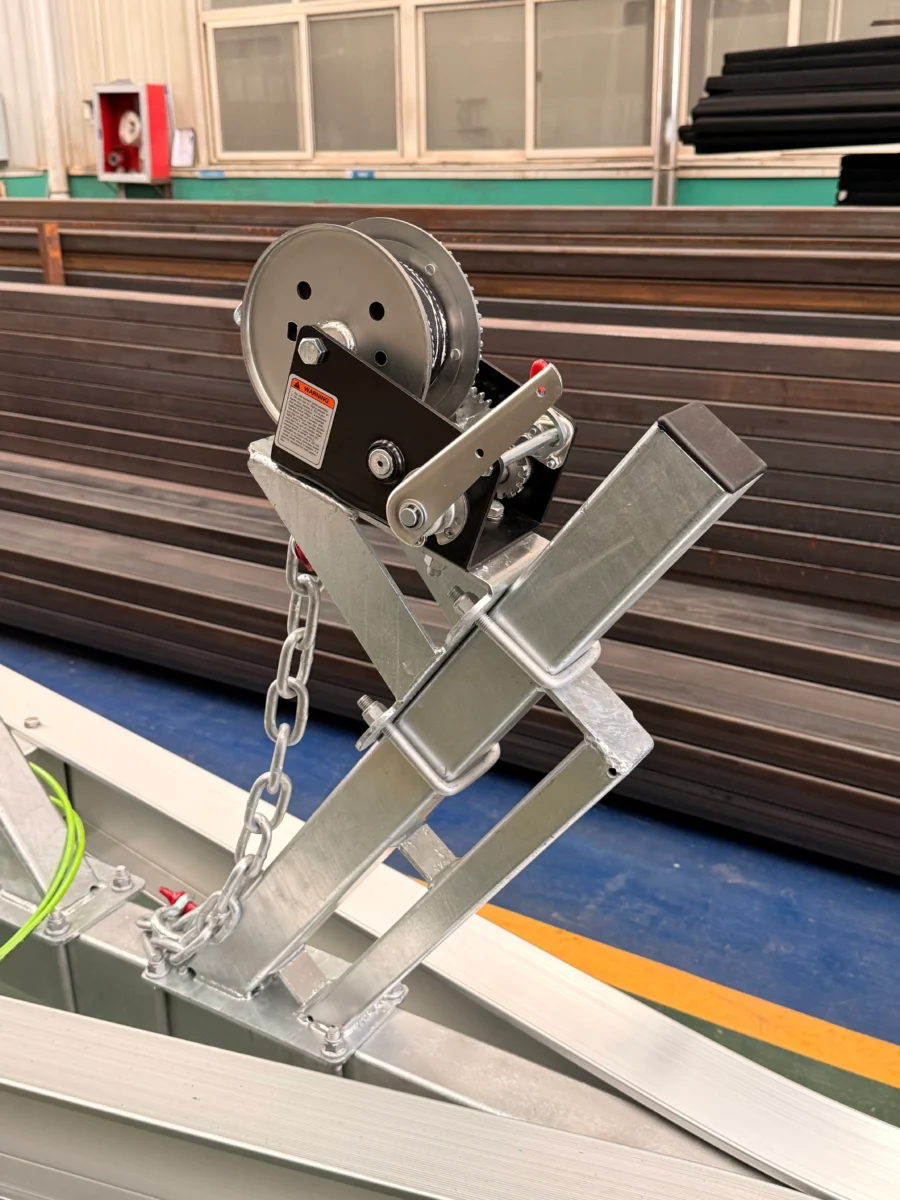
The winch post is the vertical member at the trailer nose that carries the winch, and the bow stop (or bow roller/bow rest) is the pad or roller at its top that the boat’s bow presses against. Together they define where the boat sits fore-and-aft on the trailer.
When you winch the boat forward, the bow stop takes the forward load through the winch strap and bow eye, and the hull settles onto the bunks or rollers at the correct station. If the bow stop is too low, too high, or worn, the boat can sit proud or too far back, which shifts tongue weight and can let the hull move under braking.
Adjust the bow stop height so the hull lines up with the bunks and the bow eye meets the winch strap at a straight pull, not at an awkward angle that side-loads the drum. A correctly set winch post and bow stop are what turn “strapped down” into “located and held.”
Tie-Down Straps: Transom and Gunwale
Once the bow is held by the winch, the stern needs restraint so the boat cannot bounce backward off the bunks or shift sideways. Two families of tie-down straps do this job, and most trailers use both.
Transom straps run from the trailer frame near the stern to the boat’s transom or a transom eye. They resist the boat walking backward and are often ratchet-type for a tight, secure hold. Two transom straps — one each side — are the common arrangement.
Gunwale straps (also called gunwale or side tie-downs) cross over the hull near the top edge and keep the boat from lifting or rocking on the bunks. These are often lighter cam-buckle straps, though ratchets are used where more tension is wanted.
The choice between ratchet and cam buckle comes down to how much tension you need and how much you trust the setting. Ratchets pull tighter and hold better for a heavy or tall hull but can over-compress a light hull if over-tightened; cam buckles are faster, gentler, and adequate for many smaller boats. Every strap carries a working load limit (WLL) printed on the webbing — pick a strap whose WLL exceeds the load it must restrain, and never use a strap whose rating you cannot read.
| Component | Common type | WLL guidance | Replace when… |
|---|---|---|---|
| Winch line | Strap (preferred) or cable | Match or exceed winch rated capacity | Cut, heat-damaged, rotted, or frayed |
| Transom strap | Ratchet strap, 2 per trailer typical | Use printed WLL; size to hull mass | Webbing frayed, hook worn, stretched |
| Gunwale strap | Cam buckle or ratchet | Lighter duty than transom | Edges worn, buckle slips |
| Safety chain | Welded chain + D-shackle | Rated for trailer GVWR | Corroded, elongated, or bent links |
Safety Chains and D-Shackles
Safety chains are the last line of defense if the coupler separates from the ball. They run from the trailer A-frame to the tow vehicle and should be crossed under the tongue so the coupler would drop into the cradle rather than hit the road. Use rated chain sized to the trailer’s gross vehicle weight rating, not a random length of hardware-store chain.
A D-shackle (the shackle that links the winch strap or safety chain) must be rated for the load and pinned correctly. A mismatched or under-rated shackle is a common, quiet failure point: the bow eye pulls against it every launch, so a weak shackle is a weak winch. Inspect the shackle pin for bending and the body for stretching, and replace at the first sign of wear.
Note that safety chains are a road-safety item whose exact requirements vary by jurisdiction; sizes, counts, and attachment rules differ between regions, so confirm the specifics with your local authority or a licensed inspector before traveling.
Maintenance: Straps, Corrosion, and Free Spool
The winch and tie-down system lives in the harshest part of the trailer — at the waterline, sprayed with salt or fresh water, and baked in the sun. A short maintenance routine prevents most failures.
Check the winch strap for fraying, cuts, and UV rot before every season and after any hard launch; a strap that looks suspect should be replaced, not trusted for one more trip. Rinse metal parts with fresh water after saltwater use to slow corrosion, and keep the winch internals lightly lubricated per the manufacturer’s note — but avoid greasing the strap.
The free spool (the lever that lets the drum turn freely to pay out line) should engage and disengage cleanly. A sticky free spool means the drum binds, which makes launching harder and can damage the strap. If the crank or motor feels rough, stop and service it; a winch that jams on the ramp is more than an inconvenience.
The broader care routine for the whole trailer is covered in our boat trailer maintenance guide, which pairs well with the strap and winch checks above.
Winch Capacity and Strap Comparison at a Glance
The two tables below summarize the choices so you can match components quickly. Use them alongside the sizing rule and the strap-type notes earlier in this article.
| Winch style | Best for | Power source | Key caution |
|---|---|---|---|
| Manual ratchet | Light boats, budget builds | Hand crank | Physical effort; slow when solo |
| Brake / self-locking | Steep ramps, heavier loads | Hand crank + drum brake | Confirm lock engages fully |
| Electric | Heavy hulls, solo launching | 12V from tow vehicle | Wiring and current draw must suit |
| Line material | Safety | Care | When to choose |
|---|---|---|---|
| Strap | No whip on failure; safer | Rinse, inspect for rot/frays | Default for most trailers |
| Steel cable | Can whip and cut if it fails | Spool evenly, watch for kinks | Abrasive/heavy service only |
How to Secure a Boat to the Trailer
Follow the same sequence every time you leave the ramp so nothing is forgotten. A consistent routine is what separates a boat that arrives intact from one that does not.
- Drive the boat onto the bunks or rollers until the bow meets the bow stop and the hull sits at its proper station.
- Attach the winch strap to the bow eye, then crank or power the winch until the bow is firmly against the bow stop — not just snug, but held.
- Secure the safety chain from the trailer tongue to the tow vehicle with a rated D-shackle before any road travel.
- Fasten the transom straps (one each side) from the frame to the transom, tightening with ratchets so the stern cannot walk backward.
- Add the gunwale straps over the hull if your trailer uses them, to stop side-to-side rocking.
- Do a final walk-around: check the coupler latch, the chains, every strap, the bow eye, and the winch free-spool lever is locked.
- Re-check the straps after the first few kilometres of a trip, since a fresh load can settle and need a small re-tighten.
Frequently Asked Questions
What size boat trailer winch do I need?
Use the rule of thumb of roughly 2× your loaded boat weight, including fuel, water, gear, and motor. A 3,000 lb loaded boat calls for about a 6,000 lb winch. Confirm against the trailer’s rated capacity and your ramp conditions, because a steep or slippery launch increases the effective pull.
Is a winch strap or cable better?
A strap is generally the safer choice because it will not whip or snap back if it fails, and it stores neatly on the drum. Steel cable resists abrasion and UV better but can cut and whip under tension. For most recreational launching, a strap is the standard recommendation.
Do I need transom straps if the winch holds the bow?
Yes. The winch holds the bow forward, but the stern still needs restraint so the boat cannot bounce backward off the bunks or shift sideways under braking. Transom straps do that job, and many trailers also use gunwale straps to limit hull rocking.
What does WLL mean on a tie-down strap?
WLL stands for working load limit, the maximum load the strap is rated to safely carry. It is printed on the webbing. Choose a strap whose WLL exceeds the load it must restrain, and never use a strap with a missing or unreadable rating.
How often should I replace a winch strap?
Replace the strap as soon as you see fraying, cuts, heat damage from a seized drum, or rot from trapped water — do not wait for a season. Carrying a spare strap turns a potential ruined launch into a quick roadside fix.
Are safety chains required on a boat trailer?
Safety chains are a standard road-safety requirement in most regions, sized to the trailer’s gross weight, but the exact count, size, and attachment rules vary by jurisdiction. Check the requirements that apply to you with your local authority or a licensed inspector before traveling.
Choosing the right winch, strap, and tie-down setup keeps your boat secure from the ramp to the storage yard. If you are specifying a trailer and want component ratings matched to your hull, contact us for a quote — our hot-dip galvanized twin-axle marine trailer is built for exactly this kind of saltwater service.