
A boat trailer needs brakes unless it meets two conditions at the same time: a gross weight of 3,000 lb (1,361 kg) or less, and a trailer axle weight no more than 40% of the towing vehicle’s combined axle weight. A 2,900 lb trailer can still require brakes if it fails the 40% test.
The Two Conditions in the US Brake Threshold
In the United States, a trailer is exempt from federal brake requirements only when its total weight is at or under 3,000 lb (1,361 kg) and its axle weight is no more than 40% of the sum of the towing vehicle’s axle weights — the two conditions are joined by “and”, not “or” (49 CFR 393.42(b)).
| Condition | Threshold | If it fails |
|---|---|---|
| Gross trailer weight | At or under 3,000 lb (1,361 kg) | Brakes required |
| Trailer axle weight | At or under 40% of the tow vehicle’s combined axle weight | Brakes required |
Both tests have to pass at the same time. Meeting the weight limit alone is not enough, and mistaking the two thresholds for alternatives is the most common misunderstanding about boat trailer brake requirements.
The Second Condition Almost Everyone Forgets: The 40% Axle-Weight Test
The 40% test exists because stopping a combination depends on the tow vehicle’s mass and brakes, not on the trailer’s weight alone.
Consider a 2,900 lb (1,315 kg) boat and trailer. It sits under the 3,000 lb line, so many owners assume it is exempt. If the loaded trailer’s axle weight is 2,600 lb and the tow vehicle’s axle weights total 5,200 lb, then 40% of 5,200 lb is 2,080 lb — the trailer is over that figure, and the exemption does not apply. The same trailer behind a heavier truck whose axle weights total 7,000 lb gives a 40% figure of 2,800 lb, which it passes.
The test uses axle weight rather than total trailer weight, because tongue weight is carried by the tow vehicle. The practical consequence is counter-intuitive: a lighter tow vehicle makes it harder to qualify for the exemption, not easier.
What 49 CFR Part 393 Covers — and Why Your Private Trailer Is a State Question
49 CFR Part 393 applies to commercial motor vehicles, so for a privately owned, non-commercial boat trailer the binding requirement usually comes from your state’s vehicle code rather than directly from the federal rule.
Most states set thresholds close to the federal ones, and some are stricter, particularly above 3,000 lb. Nothing in the federal exemption prevents a state from requiring brakes at a lower weight, and some do. If you tow commercially — for hire, or as part of a business — the federal rule is likely to apply to you directly.
In practice many owners fit brakes below the legal threshold anyway, because a braked trailer is easier to control in an emergency stop and on a long descent, and because a trailer that sits near the limit this year is usually over it after the next boat upgrade. Where the position is unclear, check with your local authority before assuming you are exempt.
Surge Brakes on Boat Trailers: Why They Dominate, and Their Limits
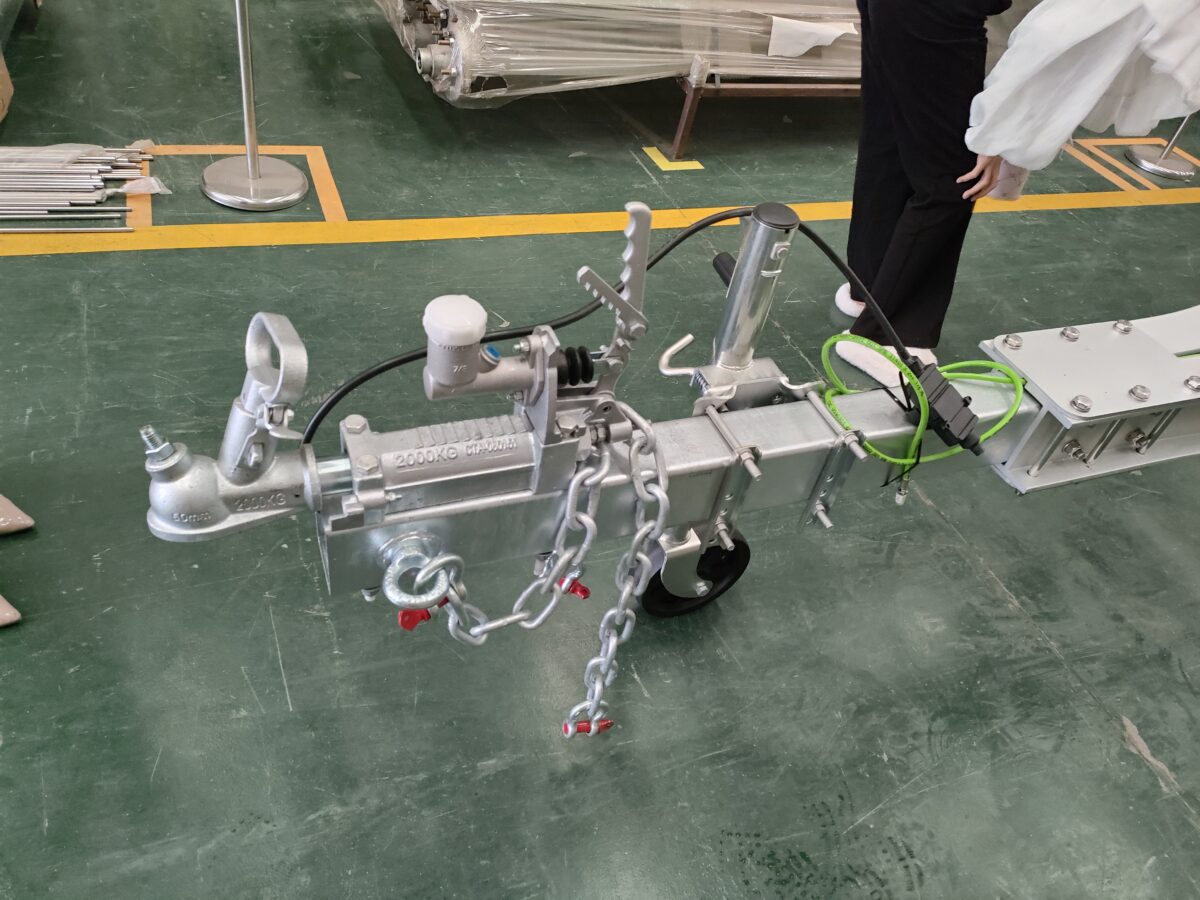
Surge brakes dominate boat trailers because they need no brake controller in the tow vehicle: the trailer generates its own braking force by pushing against the hitch as the combination slows.
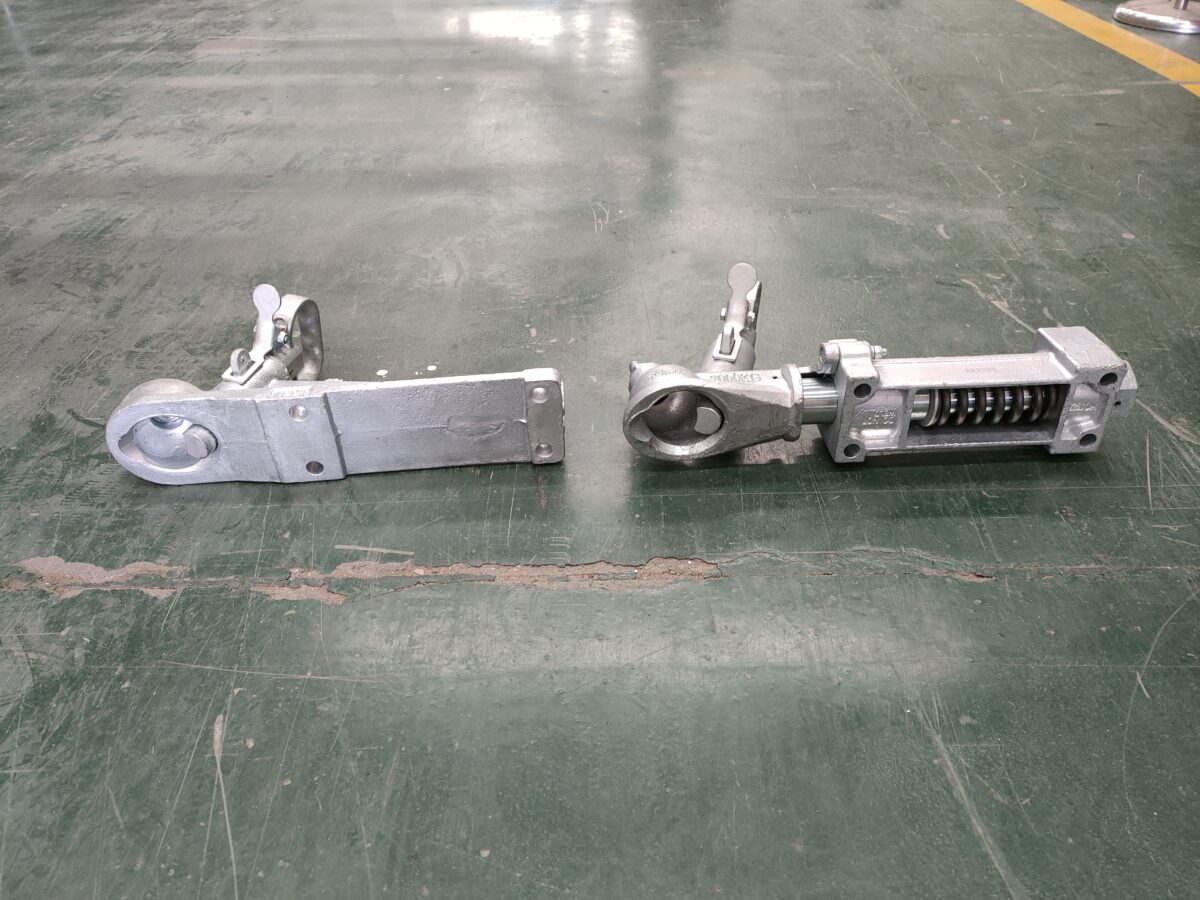
A surge actuator is a master cylinder built into the coupler. Under braking, the trailer’s momentum compresses the coupler, the master cylinder pressurises, and hydraulic pressure travels down a line to the wheel cylinders or calipers. The result is proportional braking with no wiring, no controller and no in-cab adjustment, which is why almost any tow vehicle with a compatible hitch and ball can pull the trailer.
The drawback is maintenance. The actuator sits at the front of the trailer and goes under water at every launch, and everything downstream of it is exposed to the same water: master cylinder, brake lines, calipers or wheel cylinders, and the reverse lockout circuit that lets a disc-braked trailer back up. Brake fluid absorbs moisture from the air, so a regularly dunked actuator sees contaminated fluid far sooner than a car’s brake system ever would.
| Trailer GVWR | Additional limit |
|---|---|
| At or under 12,000 lb | Trailer GVWR must not exceed 1.75 × the towing vehicle’s GVWR |
| Over 12,000 lb, under 20,001 lb | Trailer GVWR must not exceed 1.25 × the towing vehicle’s GVWR |
Those limits come from 49 CFR 393.48(d). They are the federal commercial rule; state thresholds for private trailers are similar but not identical.
Disc vs Drum Brakes in Saltwater
In saltwater use, disc brakes are almost always the better choice, because they drain as soon as the trailer leaves the ramp, they do not trap water and silt, and everything that corrodes is visible without disassembly.
| Factor | Disc | Drum |
|---|---|---|
| Water drainage | Drains as the trailer comes out of the water | Holds water inside the drum |
| Sand and silt | Falls out of the open assembly | Accumulates, grinding linings and drum |
| Inspection | Pads and rotor visible without disassembly | Drum must come off to see anything |
| Corrosion | Rotor face rusts but wipes clean in use | Springs, adjusters and wheel cylinders corrode out of sight |
| Service cost | Pads are inexpensive and quick to change | More labor, more parts |
| Braking force | Needs higher line pressure | Self-energising, more force for less input |
Drums still make sense in some situations: freshwater or occasional use where the trailer is rarely immersed, and light-duty applications where self-energising behavior is an advantage. A boat trailer running drums needs free-backing shoes or a lockout, so it can be reversed without the brakes dragging.
Breakaway Systems: Automatic Braking for at Least 15 Minutes
Every trailer that is required to have brakes must also carry a breakaway system that applies those brakes automatically if the trailer separates from the tow vehicle, and holds them for at least 15 minutes (49 CFR 393.43(d)).
The hardware is simple: a battery on the trailer powers either an electric actuator or a solenoid on a surge actuator, and a pin-and-cable assembly arms the system. The cable is the trigger — if the trailer comes off the ball, the cable pulls the pin and the brakes apply. The battery is the most common point of failure, because it is small, it is charged only through the tow vehicle’s charge line, and it is easy to forget.
Test it at least once a year, with the trailer parked and the cable disconnected from the tow vehicle: pull the pin, confirm the brakes lock and hold, then check the battery’s condition and charge. A battery that cannot hold the brakes for the full 15 minutes is a failed part, not a marginal one.
Attach the arming cable to the tow vehicle’s frame or hitch structure — never to the ball, the hitch pin or the safety chains — and set the slack so it pulls before the chains go tight while still allowing full turns. The safety chains themselves should be crossed under the tongue and rated for the load: Class I to 2,000 lb, Class II to 3,500 lb, Class III to 5,000 lb.
Rinsing and Lubricating Brakes After Saltwater Immersion
A braked trailer that goes into saltwater needs the same rinsing discipline as the hubs, because the actuator, calipers and rotors are all immersed on every launch.
- Flush the brake assemblies, hubs, actuator and breakaway battery box with fresh water after every immersion — 30 to 60 seconds is enough.
- Never point a pressure washer at seals, rubber boots or the actuator; high pressure drives water and grit past the very seals you are trying to protect.
- Let the assemblies dry before parking, and avoid leaving the trailer standing on wet ground for long periods.
- Once or twice a year, clean and lubricate the caliper slide pins and the actuator coupler pivot with a water-resistant marine grease.
- Check brake fluid annually. Glycol-based fluid absorbs moisture, and a marine actuator sees contaminated fluid far sooner than a car does.
- Check pad or lining thickness and rotor condition at the same time, and test the breakaway battery while you are there.
The hubs behind those calipers run on their own schedule — boat trailer bearings in saltwater need repacking every 6 months — and the full seasonal routine, including lights and fasteners, is set out in our boat trailer maintenance guide.
How Other Markets Draw the Brake Line
Brake thresholds differ by market, and the category names are what catch importers out, because a trailer that counts as “light” in one country can fall into a braked category in another.
| Market | Framework | Key threshold |
|---|---|---|
| United States | 49 CFR Part 393 for commercial vehicles; state law for private trailers | At or under 3,000 lb (1,361 kg) plus the 40% axle-weight test to be exempt |
| European Union | Regulation (EU) 2018/858; UN Regulation No. 13 | O1 up to 0.75 t not required; O2 above 0.75–3.5 t mandatory, overrun permitted |
| Australia | Road Vehicle Standards Act 2018 (RVSA); VSB1 Revision 6 | Low ATM trailer is 4.5 t or under; braking scales with ATM and the relevant ADRs |
| New Zealand | NZTA requirements | Light trailer is 3,500 kg or under; braking scales with mass — confirm thresholds with NZTA |
Two details are worth carrying into a specification discussion. In the EU, overrun (inertia) braking is permitted only on non-semi-trailers, and the towing vehicle’s permissible maximum mass must be at least 1.33 times the trailer’s maximum mass. Elsewhere, category codes, the RAV entry process in Australia and the fee structure are covered market by market in our guide to boat trailer regulations by country.
A Practical Decision Flow for Your Own Rig
Work through these steps in order and the answer to “do I need brakes” usually becomes clear before the end.
- Establish the loaded gross weight of the trailer, using a scale or the trailer’s GVWR plate as the starting point.
- Look up your state’s threshold for private, non-commercial trailers — that is the rule that governs you.
- If you are under 3,000 lb (1,361 kg), run the 40% axle-weight test before assuming you are exempt.
- Choose the brake type. Surge is the default for boat trailers because it needs no controller and no tow vehicle modification; electric brakes need a controller, and their drums are not designed to be submerged.
- Size the system to the trailer’s GVWR and axle count; a tandem-axle trailer carries more braking capacity than a single axle.
- Verify the breakaway system: battery condition, arming cable attachment and safety chain rating.
- Set the maintenance routine: rinse after every launch, check fluid annually, lubricate the pins.
Frequently Asked Questions
Do boat trailers need brakes?
In the US, a boat trailer needs brakes unless it weighs 3,000 lb (1,361 kg) or less and its axle weight is no more than 40% of the tow vehicle’s combined axle weight. Most trailers above that threshold use surge brakes. Private, non-commercial trailers are governed by state law, which is usually close to the federal rule.
What weight requires brakes on a boat trailer?
Any trailer over 3,000 lb (1,361 kg), and some trailers under it: if the loaded trailer’s axle weight exceeds 40% of the tow vehicle’s combined axle weight, brakes are required regardless of weight. Many states also set their own, sometimes lower, threshold.
What is the 40% rule for trailer brakes?
It is the second half of the federal exemption test. The trailer’s axle weight must be at or under 40% of the sum of the towing vehicle’s axle weights, which is a measure of whether the tow vehicle has enough mass and braking to control the combination. A lighter tow vehicle makes the test harder to pass.
Are surge brakes or electric brakes better for a boat trailer?
Surge brakes suit most boat trailers because they need no in-cab controller and work with any compatible tow vehicle. Electric brakes give finer control and are common on heavier trailers, but their drums are not designed to be submerged at every launch, which is why surge and hydraulic systems dominate on boats.
How do I test my trailer breakaway system?
Park the trailer, disconnect the arming cable from the tow vehicle, and pull the pin. The brakes should apply and hold for at least 15 minutes. Check the battery’s charge and condition at the same time — a battery that cannot hold the brakes for the full period has failed and needs replacing.
Do boat trailer brakes need maintenance after saltwater?
Yes. Flush the actuator, calipers, rotors and battery box with fresh water after every immersion, lubricate the caliper slide pins and coupler pivot once or twice a year, and check the brake fluid annually, because glycol-based fluid absorbs moisture and a marine actuator is exposed to water constantly.
If you are specifying a braked boat trailer, the axle rating, brake type and breakaway hardware have to match your boat, your tow vehicle and the market you register the trailer in. Hyroad Trailer manufactures marine platforms including the hot-dip galvanized twin-axle marine trailer, and holds ISO, WMI, CE, US DOT, EU WVTA and Australian VTA certifications. Tell us your boat weight, tow vehicle and destination market — contact us for a quote.