
Choosing the right boat trailer support system is critical for safe launching, hauling, and long-term hull protection. For boat owners, dealers, and marine transport professionals browsing hyroad trailer, three primary trailer configurations dominate the market: roller boat trailers, bunk (wooden skid) boat trailers, and skid boat trailers. Each design features unique structural advantages, load-bearing capabilities, and ideal use cases for different boat hull types, water ramp conditions, and transportation scenarios.
In this comprehensive guide, we break down the core differences between roller, bunk, and skid boat trailers, analyze their pros and cons, and help you select the optimal trailer for your marine equipment—optimized for global marine trailer search queries and regional boating application scenarios.
1. Core Definition of Three Boat Trailer Support Systems
Before comparing performance and applications, it is essential to clarify the basic structure of roller, bunk, and skid boat trailers, as their mechanical design determines their functional boundaries.
1.1 Roller Boat Trailers
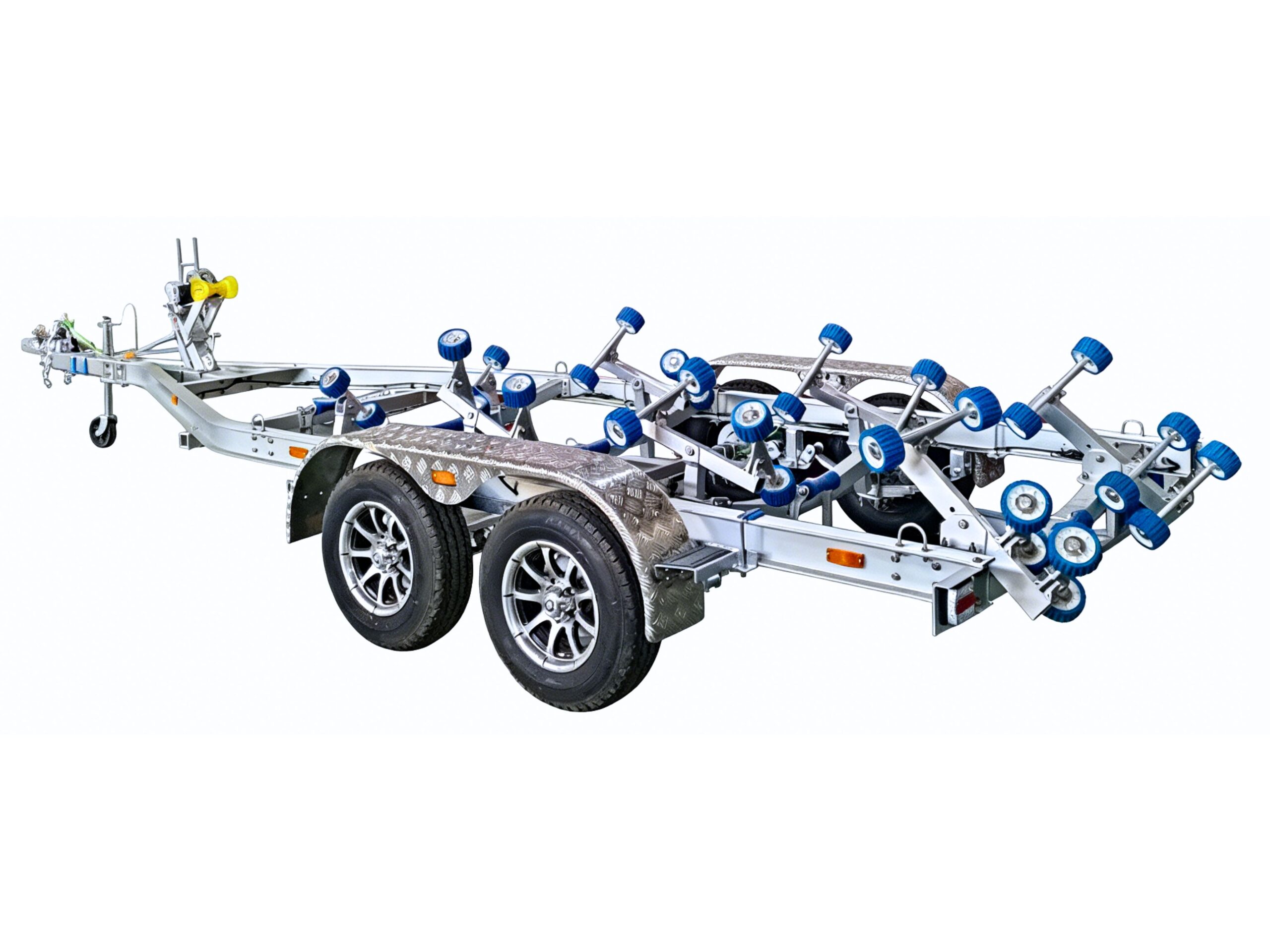
Aroller boat trailer features a series of rotating rubber or polyurethane rollers installed on adjustable brackets along the trailer frame. The rollers align with the boat’s keel and hull sides, creating a low-friction contact surface. Most roller trailers include wobble side rollers that pivot automatically to fit varying hull angles, ensuring centered support during loading and unloading. This design focuses on sliding-assisted launching and retrieval, eliminating rigid friction between the boat and the trailer frame.
1.2 Bunk (Wooden Skid) Boat Trailers
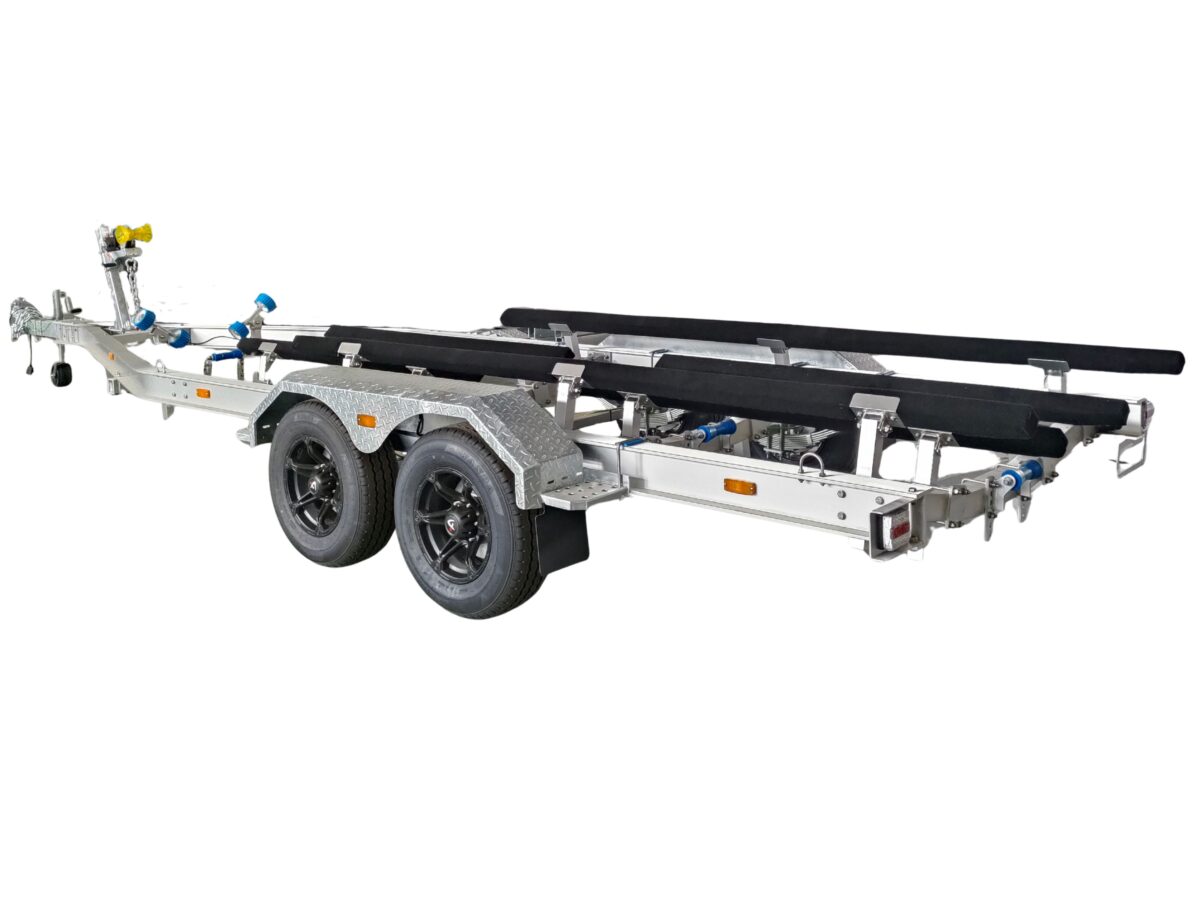
Commonly known as wood bunk trailers, bunk boat trailers use long, flat wooden or composite plank bunks covered with carpet as the main load-bearing structure. Fixed symmetrically on both sides of the trailer frame, the wide bunk surfaces provide full-area contact with the boat’s hull bottom. As the most traditional and cost-effective marine trailer design, bunk trailers prioritize stable static load-bearing for long-distance road transportation.
1.3 Skid Boat Trailers
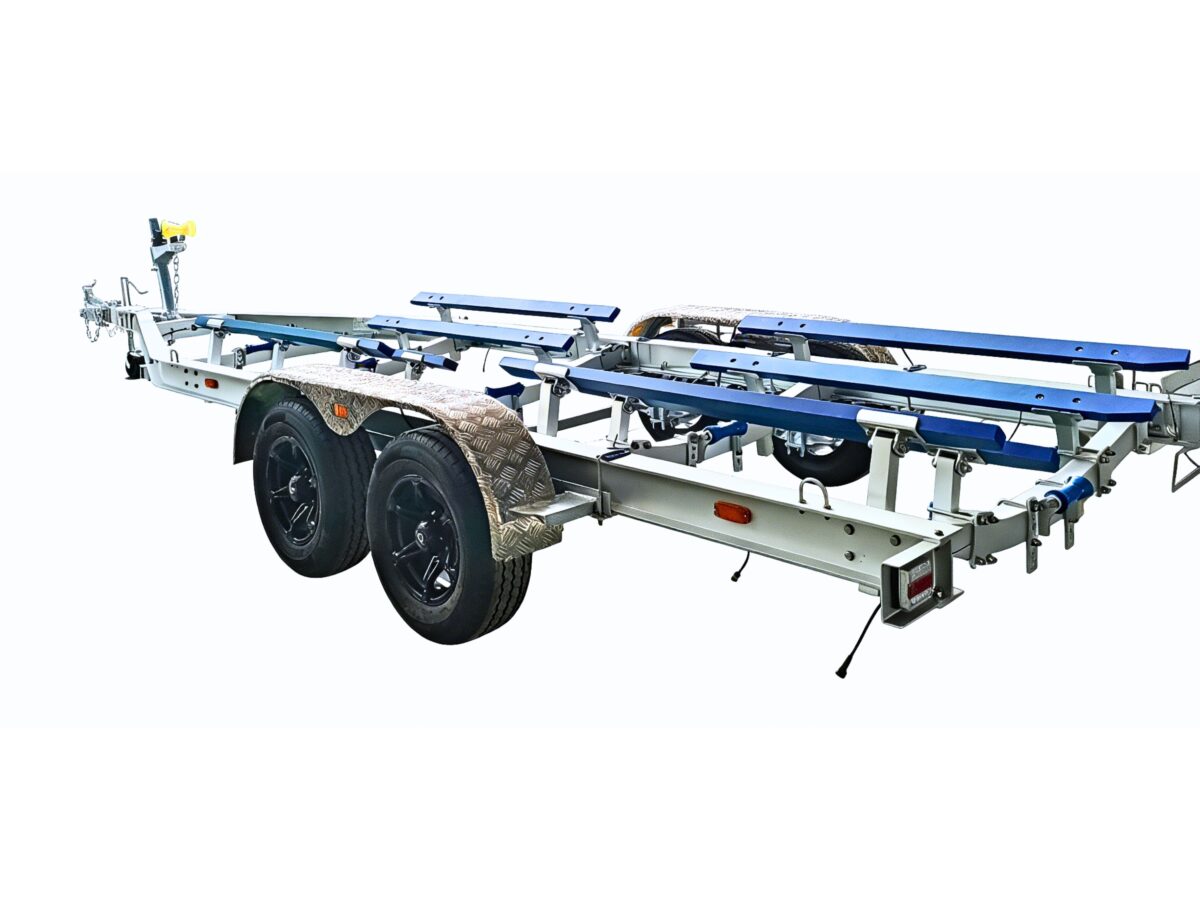
Skid boat trailers adopt simplified narrow rigid skid strips (metal or high-density plastic) instead of wide bunks or movable rollers. With fewer contact points and a streamlined structure, skid trailers are lightweight, highly adaptable, and designed for short-distance transfer and harsh ramp conditions. They strike a balance between the simplicity of bunk trailers and the flexibility of roller trailers, serving as a versatile transitional trailer solution.
2. Key Differences Between Roller, Bunk, and Skid Boat Trailers
The three trailer types differ significantly in friction performance, hull adaptability, launch conditions, maintenance requirements, and transportation stability. Below is a detailed comparison of their core functional differences for marine and road application scenarios.
2.1 Friction & Launch/Retrieval Performance
Roller boat trailers deliver the lowest friction coefficient among the three designs. The rotating roller structure allows boats to slide on and off the trailer effortlessly, even in shallow water, muddy ramps, or uneven shorelines. Users can complete launching and retrieval solo without extra manpower, making them ideal for rough or undeveloped boat ramps. The adjustable roller positioning also prevents hull scraping during sliding.
Bunk boat trailers rely on carpet-covered static contact, resulting in higher friction. Smooth launching requires fully submerging the bunks in deep, calm water to reduce resistance. They perform poorly in shallow water or on steep, uneven ramps, as excessive friction makes it difficult to slide the boat off the trailer without manual pushing or towing assistance.
Skid boat trailers feature moderate friction. Their narrow rigid skids reduce contact area compared to bunks, enabling easier sliding than bunk trailers. However, without rotating rollers, they still require deeper water than roller trailers for smooth launching. They work best on flat, standard ramps with moderate water depth.
2.2 Hull Adaptability & Load-Bearing Stability
Roller trailers are optimized for V-hull boats, fiberglass runabouts, and offshore fishing boats. The combination of keel rollers and flexible side rollers perfectly fits the curved V-shaped hull, providing targeted support for the keel and avoiding local pressure concentration. However, they are less suitable for flat-bottom boats, which may shift slightly on discrete roller points during high-speed transportation.
Bunk trailers excel with flat-bottom boats, pontoon boats, aluminum fishing boats, and inflatable boats. The wide full-contact bunks evenly distribute the boat’s weight across the entire hull bottom, eliminating pressure points and ensuring ultra-stable load-bearing. For heavy large-size boats, bunk trailers provide superior road stability during long-distance highway transportation.
Skid trailers offer universal adaptability for small to medium-sized boats, including flat-bottom, slight V-hull, and jet boats. Their narrow skid design avoids excessive contact with complex hull surfaces and reduces dirt and water accumulation. While their overall stability is lower than bunk trailers, they deliver better centering performance than full roller trailers for daily light-duty use.
2.3 Maintenance & Service Life
Roller boat trailers require the highest daily maintenance. Long-term water immersion and sun exposure cause roller aging, bearing rust, and rubber cracking. Users need to regularly inspect roller rotation flexibility, replace worn rollers, and clean rusty brackets to avoid hull jamming during launching. Despite higher maintenance costs, well-maintained roller trailers have a long overall service life.
Bunk boat trailers feature simple structures and low maintenance needs. High-quality composite or pressure-treated wood bunks with anti-UV carpet resist water corrosion and wear. The main maintenance work includes regular carpet cleaning and occasional bunk replacement after long-term use. Their fault rate is far lower than roller trailers, reducing long-term use costs.
Skid boat trailers have the lowest maintenance requirements. The rigid metal or plastic skids are wear-resistant, corrosion-proof, and not prone to deformation or damage. With no movable parts, there is almost no daily maintenance, making them a hassle-free option for casual boat users.
2.4 Cost & Application Scenario Differentiation
In terms of upfront costs, skid trailers are the most affordable, followed by bunk trailers, while roller trailers have the highest purchase price due to their complex adjustable roller systems.
Roller trailers are tailored for offshore boating, frequent shallow-water launching, solo boat operation, and remote undeveloped ramps. Bunk trailers are the top choice for inland waterway boating, long-distance road haulage, large heavy boats, and fixed standard ramp use. Skid trailers are ideal for short-distance daily transfer, small boat casual use, and budget-friendly marine transportation.
3. How to Choose the Right Boat Trailer: Roller, Bunk, or Skid?
To match your boating habits and equipment perfectly, follow this targeted selection guide based on global user scenarios:
- Choose a roller boat trailer if you own a V-hull fiberglass boat, frequently launch in shallow or rough water, boat alone, or use non-standard shore ramps. It prioritizes launch convenience and hull protection in complex water conditions.
- Choose a bunk boat trailer if you have a pontoon boat, flat-bottom fishing boat, or heavy large boat, mainly use standard deep-water ramps, and need stable long-distance road transportation. It delivers superior load uniformity and driving safety.
- Choose a skid boat trailer if you own a small to medium-sized boat, pursue cost-effectiveness and low maintenance, and only need daily short-distance transfer and regular ramp launching. It offers balanced performance for entry-level marine transport needs.
4. Final Verdict & Professional Recommendations
There is no absolute “best” boat trailer type—only the most suitable one for your specific application. Roller trailers focus on launch flexibility and complex environment adaptability; bunk trailers excel at transport stability and heavy-load bearing; skid trailers win with simplicity, durability, and cost performance.
At hyroadtrailer.com, we provide customized roller, bunk, and skid boat trailers compatible with all mainstream boat types worldwide. All our marine trailers adopt high-strength frame materials, anti-corrosion surface treatment, and optimized support structures to ensure safe, stable, and long-lasting marine transportation and launching.
FAQs About Roller, Bunk & Skid Boat Trailers
Q1: Are roller trailers better for boat hull protection?
Yes. The low-friction rotating roller design avoids rigid scraping during launching and retrieval, effectively protecting fiberglass and painted hulls from scratches, especially for high-end offshore boats.
Q2: Do bunk trailers cause hull damage easily?
No. Carpet-covered bunks provide soft, full-area contact. As long as the bunk position matches the hull, they distribute pressure evenly and cause no hull damage, making them safer for long-distance transportation.
Q3: Are skid boat trailers suitable for heavy boats?
Skid trailers are more suitable for small and medium-sized light boats. For heavy boats over 3 tons, bunk trailers are recommended for better load-bearing stability and driving safety.